How School Soccer Coaches Can Keep Players Touching the Ball When Practice Time is Limited
High school soccer training at home works when the coach assigns short, specific ball work and checks the rules first. Ask your athletic director and state association what counts as coach-directed activity in your window, then use 15 to 30 minutes of countable ball mastery on days without practice, the plan I run with my 11U team.
I'm Matt McWilliams, co-founder of Train Daily and head coach of an 11U team in a homeschool club. That is not a high school program. It shares some of your pressures: a short season, a roster cut, and a state tournament on a fixed date. I'll mark where my experience stops.
Can a school soccer coach assign training at home?
It depends on your state association and your school, so ask before you assign anything. Rules on coach-directed activity outside the season vary by state, and I can't tell you what yours say. This post is not legal or regulatory advice.
Ask your athletic director three questions before you send a single assignment:
- Which dates count as in-season, preseason, and out-of-season for soccer in your state?
- Does coach-directed work outside the season have to be optional?
- What does the school require before students use an app that collects their information?
Write down the answers and keep them with your season plan. A short email to the athletic director today saves a harder conversation after a parent calls.
What should you assign when practice time is short?
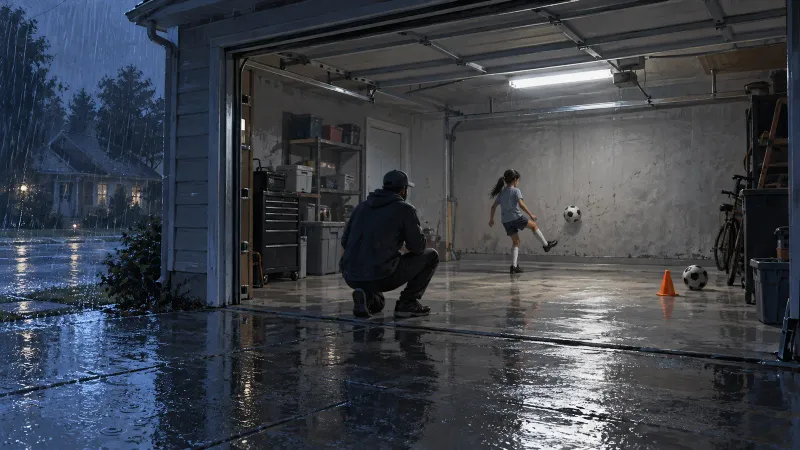
Ball mastery on both feet, in one assignment with a count and a time limit. Mine runs 15 to 30 minutes on non-practice days and sounds like this: "50 inside-foot passes with your left against the wall in 10 minutes." A player can finish it alone with a ball and a wall, and it contains no fitness work.
Other assignments follow the same pattern: wall passes with the weaker foot until you reach a set number of clean ones, a juggling count with a time limit, or a dribbling circuit through cones using only the outside of each foot. Each one has a skill, a count, and a finish line.
The reason is simple. When a first touch is automatic, the brain is free to make decisions. Off days carry the repetitions that practice can't fit, so you can spend your limited sessions on the team shape.
I keep at least 85% of session time in environments where attack, defense, and transition all show up. That leaves little room for isolated touches, and the home assignment takes up the slack. Add a scanning layer when you can: a parent or sibling holds up fingers, and the player calls out the number before the next touch.
What happened with my team before the season opened?
In the two weeks before my season, 13 of my players used Train Daily. On day one, their touch was way ahead of the same team a year earlier. That's my observation as their coach, not a controlled test, and Train Daily is my app, so weigh it accordingly.
My window looked like this: a five-day tryout across two weeks in late July, and a season opener on August 21, 2026. That's short, and the home work covered the days between.
If you want a way to see who finished, Train Daily for coaches lets you assign the day's drill from a video library, add a reinforcement question, and track completions on a team-only leaderboard. Check your school's app requirements first.
How should you use the practice sessions you do have?
Teach the big ideas first and repeat them. My season plan front-loads the overarching themes in the first five weeks, and each theme gets spaced retrieval once the next one lands. Weeks five through nine are for review, fixing, and sharpening, so the team peaks for the tournament instead of still learning its shape.
Two priorities run every week of that plan: scanning and possession. Everything else gets taught once and reinforced. Kristine Lilly has said she watches a game, sees six problems, and then teaches nothing well. I picked that up as a warning, and it's why I pick one or two things per season and teach those well.
My season runs about 11 weeks. If yours is shorter, you'll have to compress the plan, and I haven't tested a compressed version.
How do you keep a short season from turning into a lecture?
Time your talking. If I'm talking for more than 20 seconds, I don't know what I'm intervening about, and past 45 seconds is far too long. I time myself now. Short, simple, step in, step out.
Pavel Buzeko, a coach at Cambridge United, says 60 to 70% of his coaching time is observing and only about 30% is coaching tailored to what he saw. I had mine inverted. Standing with a notepad while parents watch feels like doing nothing, and it leaves the practice minutes to the players.
What should you teach first in a short season?
Teach scanning first. Scanning means looking around before the ball arrives, so the player already knows what to do with it. My players hear "Picture, then ball" at every practice from day one. If I could teach only one thing in a season, it would be that habit, because it separates a player who reacts from a player who's three steps ahead.
Possession runs next to it. I define possession as the ball going from one player to a teammate, whether that's one pass or thirty-one, to move the opposition and create space. If the space opens behind them, play it in behind.
What does the last week before the tournament look like?
Cut volume and protect fresh legs. In my plan, the last practices before the state tournament are three-minute games between three teams, with one team sitting out each round and no player going more than three games straight. Off days stay ball mastery.
Game weeks get lighter in general. The session before a game shifts to reminders, not new installs, because match day is for reminders. I'm also considering dropping losers-run-a-lap in the final week for a consequence that doesn't cost anyone their legs.
Will teenagers do the work?
I don't know. My players are 9 to 11, and I haven't coached teenagers. The mechanism I use is a visible record and a team-only leaderboard, and I can only vouch for how it works with my age group.
Test it with your roster. Give every player the same assignment for two weeks, make completion visible, and watch who finishes. My team plan builds in 75% of players completing 75% of the work, so use that as your first benchmark.
What should you tell parents and your athletic director?
Set the sideline expectation at the same time. At my parent meeting I ask for one thing: cheer, don't coach. When a kid hears a voice from the sideline giving instructions, the kid stops reading the game and starts listening for directions. That undoes the scanning you taught all week.
Put the assignment, the time, and whether it's optional in one message. In week one, my Friday message to parents ended with three sentences about what the kids could do on Sunday and where to find it. A clear note spares parents from guessing.
Send your athletic director the same message before it goes to families. Ask for approval in writing if your school requires it. That keeps your plan inside whatever your school and state association allow.
Coaching a club roster instead? How youth soccer coaches can get players to practice on off days covers the same plan without the school-rules layer.
What to do this week
- Email your athletic director the three rules questions and write down the answers.
- Write one assignment with a skill, a count, and a time limit.
- Pick one way to see who finished, and set a benchmark of 75% of players doing 75% of the work.
Frequently asked questions
Is it OK for a high school coach to assign soccer training at home?
It depends on your state association and school. Rules on coach-directed activity outside the season vary, so ask your athletic director and check your state association before you assign anything. Get the answers in writing and keep them with your season plan. This is not legal or regulatory advice.
How long should an at-home soccer session be?
My plan for ages 9 to 11 uses 15 to 30 minutes of ball mastery on days without practice. I haven't tested it with teenagers, so treat that range as a starting point and adjust to your roster and your school's rules.
What should a high school player do between practices?
Ball mastery with a count and a time limit, such as 50 inside-foot passes with the weaker foot against a wall in 10 minutes. Add a scanning layer by having someone hold up fingers while the player calls out the number.
How do you track whether players did the work?
Pick one visible record: an app with a leaderboard, or a shared tally. I co-founded Train Daily, which tracks completions and streaks on a team-only leaderboard. Whatever you pick, check your school's requirements for apps that collect student information, and ask your athletic director what the school expects before families see the plan.
How do you keep an at-home plan from becoming a fitness plan?
Write the assignment as ball mastery only. My off-day plan includes no sprints or fitness work, and my players get conditioning from games. For a conditioning plan, work with your athletic director and athletic trainer, who know your players and your state's rules.