How Youth Soccer Coaches Can Teach Scanning to Young Players
To teach scanning in soccer, build a drill where a player physically cannot take a touch without looking first, then carry that same demand into a scrimmage where a good scan earns points on its own. Here's the scan-and-receive drill I run with my 11U team, the cue that makes it stick, and the exact scoring split from a 3v3 tournament format that rewards looking up as much as it rewards scoring.
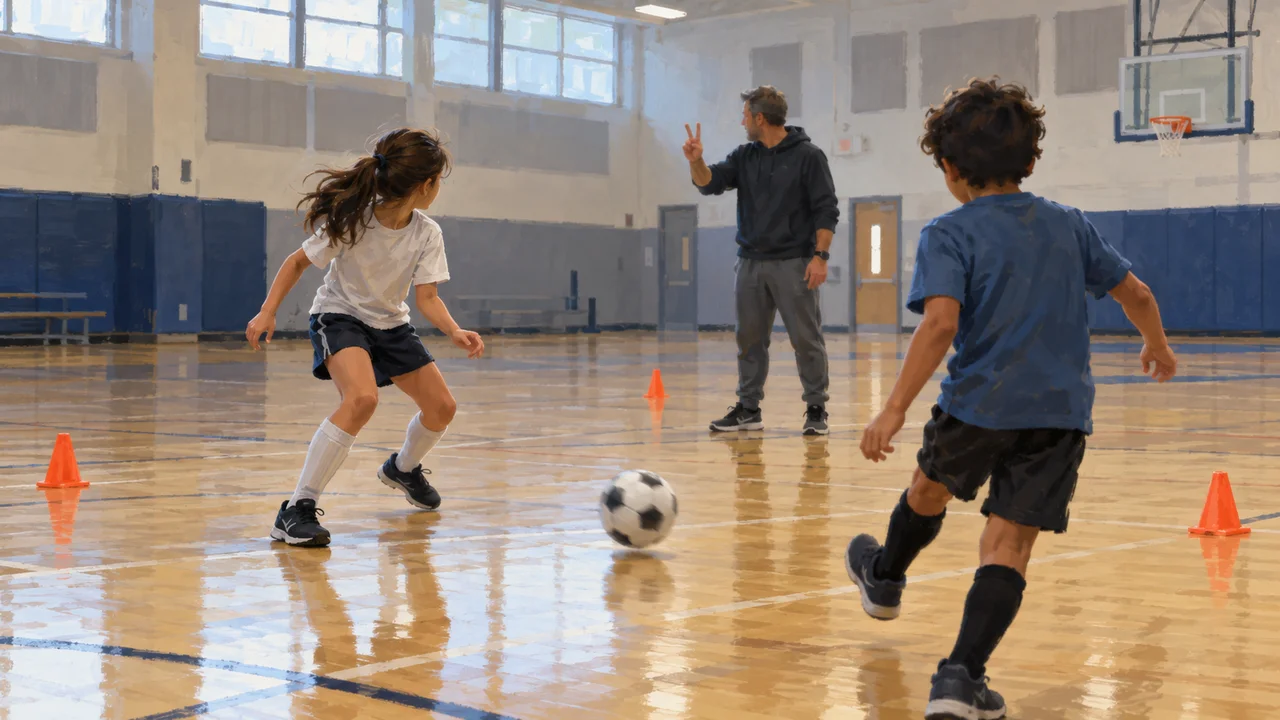
I co-founded Train Daily and coach an 11U team in Fort Wayne, IN that plays 9v9. If I had to pick one habit to teach above everything else this season, it would be scanning. A player who looks before the ball arrives already knows what he's doing with it. A player who doesn't is reacting a half-second behind the game all night. Here's the drill I use to teach it, plus how I score it in a scrimmage so looking up carries real weight.
What is scanning in soccer, and why coach it on purpose?
Scanning is looking around the field before the ball arrives so a player already knows where the open teammate is, where the pressure is coming from, and what he's going to do with his first touch. It sounds obvious once you say it out loud, which is exactly why most teams never drill it directly. Coaches tell players to "look up" from the sideline all season and wonder why it never sticks, because telling isn't the same as teaching it.
My cue for this is two words: "Picture, then ball." Take the picture with your eyes before the ball gets there, then deal with the ball. I say it at every practice, tie it to whatever phase we're in that moment, and ask "what phase are we in?" until the players start asking it themselves instead of me. Scanning is the thing that makes the rest of my possession work function, not a standalone skill I drill off to the side. A player with a clean first touch and no picture in his head still has nowhere good to put the ball.
Scanning works best when it's layered onto a planning structure the rest of your session already follows. My post on how to plan a youth soccer practice covers the Play-Practice-Play shape I build every session around, including where a theme like scanning fits across a full two hours.
How do you actually drill scanning instead of just telling players to look up?
Here's the drill I ran with my team this season to install scanning directly instead of hoping it shows up on its own. Set up groups of three with a ball. One player serves, one receives in the middle facing the server, and one stands behind the receiver holding up a number of fingers. Before the server plays the ball, the receiver has to glance over his shoulder and call out the number the back player is showing. Then he receives on his back foot, takes his first touch away from where that back player is standing, and passes to the next server. Two touches, that's it: look, touch away, pass.
What I watch for is timing, not effort. The head turn has to happen before the ball arrives, not as it arrives. A player who glances back after the ball is already at his feet has learned nothing, because the whole point of scanning is knowing the answer before the question shows up. The touch also has to go somewhere useful. A kid who looks, calls the right number, and then taps the ball straight back into traffic hasn't used the information he just gathered.
Once that version feels automatic, usually inside eight minutes, I stop having the back player hold a static number and have him drift a step to one side instead. Now the receiver has to look, read which side the pressure is on, and open his body away from it rather than just reading a number. The next progression adds a second server on the opposite side, so the receiver has to scan, read where the pressure is, and choose which server to open toward. That's the version that bridges straight into a real defender closing you down for real, which is where I take it the following session. Rotate every three or four reps so nobody stands around waiting: the server becomes the receiver, the receiver becomes the back player, and the back player rotates out.
This drill plugs straight into a bigger exercise bank once your players have the scanning piece down. My post on building a 9v9 practice plan covers the full bank I build a session around, including which exercises carry a scanning demand of their own.
How do you score scanning in a scrimmage so it's not just about goals?
Drills teach the mechanics, but scrimmages are where scanning either survives contact with a real game or doesn't. I run a 3v3 tournament format specifically to test that. Split your group into several small teams, play round-robin games of seven to nine minutes each, and rank teams by point differential across the whole tournament rather than by any single game.
The scoring split is what makes this work: 3 points for a goal, 1 point for a good scan and a clean receive on the back foot. A team can lose the goal count and still win the tournament on scanning points, which is exactly the incentive you want. Watch closely for the head-turn-before-the-ball pattern from the drill above, and award the point the same way in a live, moving game that you did in the static setup.
One real wrinkle worth knowing before you run this: standards have to start loose. If nobody earns a scanning point in the first two or three minutes, players forget the point exists and stop trying for it. I keep the bar generous early, then tighten it as the tournament goes, which shows up in the numbers: a rough 6 to 10 scanning points in the first game, 5 to 8 in the second, and 3 to 6 by the third as the easy ones dry up and only the clean reads still score. That drop is the standard doing its job, not the drill falling apart.
How do you build scanning into warm-ups instead of treating it as a separate block?
Scanning doesn't need its own 20-minute slot every night to stick. Our club runs a combined warm-up across three 9v9 teams and about 40 players, coordinated by Zach and Shelly Netherton, and we fold a scanning overlay into whatever ball mastery work is already happening: hold up fingers or call out colors while the players are juggling or passing, and have them call back what they see without breaking their touches. It's two reps for the price of one instead of a separate drill competing for time.
Hold one or two priorities for a few weeks instead of changing the wrinkle every night. We ran "juggling with a scan call" for a stretch, then moved to "two-touch passing with a turn" once the first one stopped needing conscious effort. A roster this size means a new instruction every single practice leaves half the group still catching up when you've already moved on to something else.
On other nights I stack the same demand onto a rondo instead of the warm-up. A four or five against one or two keep-away, with the two defenders in the middle working as a pair so one cuts off a passing lane instead of both chasing the ball at once. The twist is the same as everywhere else: a coach holds up fingers the whole time, and the ball doesn't move until the player on it calls out the number. It's a possession drill and a scanning drill running at the same time, the same stacking approach as the warm-up above: get two jobs done in one rep instead of carving out a separate block you don't have time for.
How do you carry scanning into defending, not just possession?
Most scanning content stops at receiving the ball, but the habit matters just as much when you don't have it. My cue for defensive scanning is a longer version of the same idea: "Ball, then picture, then ball." Check the ball first, take the picture of the space and the runners around you, then check the ball again before you commit. It pairs with a recovery cue I use constantly: "Beaten? Sprint goal-side," which is the fast part of a four-word defending sequence, fast, slow, side, low.
I've watched the same breakdown show up two different ways against two different opponents in one season: a team that quits chasing the play entirely after getting beaten once, and a team that loses its mark completely because a defender's eyes never leave the ball in front of him. Different symptoms, same root cause. Both are a phase 2 scanning failure, not a fitness problem or a talent gap, and both get fixed by the same demand: keep your head up and know where you are relative to the ball and your mark, not just where the ball is.
Between-practice reinforcement is what keeps a scanning habit from decaying between Monday and Thursday. My post on getting players to practice on off days covers how I assign specific, countable work for the days in between so a theme like this one doesn't reset every week.
What to do this week
- Run the scan-and-receive drill for at least two sessions with the static number call before adding the drifting defender progression.
- Add a scanning point value to your next small-sided scrimmage or 3v3 format, starting loose for the first few minutes and tightening the standard as it goes.
- Pick one cue, such as "picture, then ball," and repeat it at every practice for a month instead of introducing a new phrase every week.
A scanning habit built in practice only compounds if it keeps getting reinforced between sessions. Train Daily for coaches lets you assign a specific scanning-focused drill from a video library in about two minutes a day and see who actually did the work before the next practice.