How to Improve Your Kid's First Touch at Home
If you want to improve your kid's first touch in soccer, the fastest path is turning touches into a short, countable home habit instead of a longer practice. A good first touch buys a player an extra half-second to decide what's next. A poor one spends that half-second chasing the ball back down. Here's how to build it at home, including the exact decision I teach my own team to make with their first touch, and why a tryout tool I built scores it as its own category.
I co-founded Train Daily and coach an 11U team in Fort Wayne, IN. First touch comes up more than almost any other skill question from parents, probably because it's the one thing you can watch and immediately tell if it's missing: the ball bounces away, the kid chases it, and the play that was open a second ago is gone. The good news is that first touch is one of the most trainable things in the sport, and you don't need a field or a coach to build it. You need a wall, a ball, and about ten minutes.
What does "improving first touch" actually mean?
A good first touch has two parts: direction, where the ball goes, and speed, how far it travels away from you. Get both right and the ball ends up close enough to control but far enough from your feet that you can move with it immediately. Get either wrong and you're stopping to reset before you can do anything else.
The payoff is what the touch frees up, not the touch itself. When a first touch is automatic, the brain doesn't have to spend any effort on it, which means it's free to do the harder job: scanning the field, picking a target, deciding what happens next. A player who has to think about controlling the ball can't also be thinking about where to play it. That's the whole case for repetition. You're not drilling the move for its own sake. You're buying back brain space for everything that happens after the touch, which is also the half-second a defender needs to recover position and close the passing lane that was open a moment earlier.
Why do some clubs score first touch as its own tryout category?
At my club's tryouts this summer, we scored every player in TryoutHelper, the evaluation tool I built, across five categories: first touch, soccer IQ, defending, speed and agility, and coachability. First touch gets its own line instead of getting folded into "technical ability" because it shows up in isolation from athleticism. A kid can be fast and still have a first touch that bounces three feet away from his foot most of the time, and a kid who isn't the quickest player on the field can still control a ball better than anyone else at tryouts. Scoring it separately catches that.
One note on how we used those scores: the top score at our tryouts was 8.7, and four players had no tryout score at all, including one who missed tryouts for other commitments and got added after an in-practice evaluation. She became one of our top scorers for the season. The numbers were a starting point for building a roster, not a verdict on any one player, and first touch is exactly the kind of score that keeps moving once a kid starts doing real reps on it.
A scored tryout category only matters if a kid gets the reps to move the number. My post on what a 9-year-old should be practicing at home covers the full skill checklist for that age, including where first touch fits alongside scanning and decision-making.
What's the best way to practice first touch at home?
Anson Dorrance's program at UNC builds first touch through six core moves, inside and outside the foot, both feet, repeated constantly after every practice. The goal was never complexity. It was repetition until the moves were automatic, which freed up brain space for everything else: scanning, decision-making, finishing. That's the model to copy at home: simple contact, both feet, a count and a time limit so your kid knows exactly when the work is done.
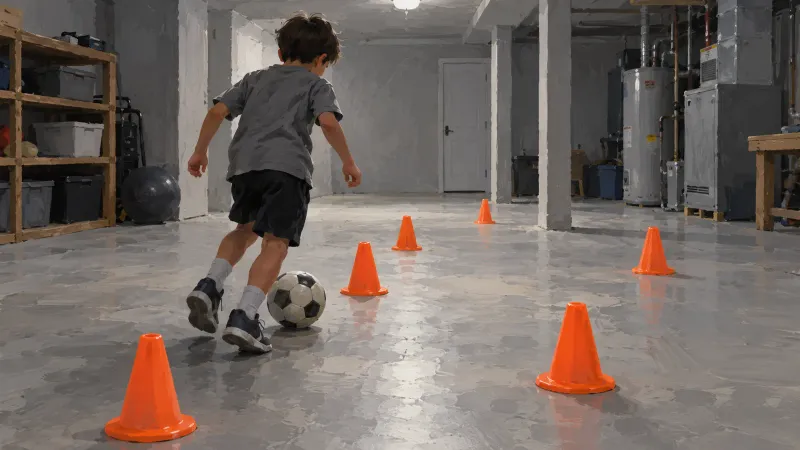
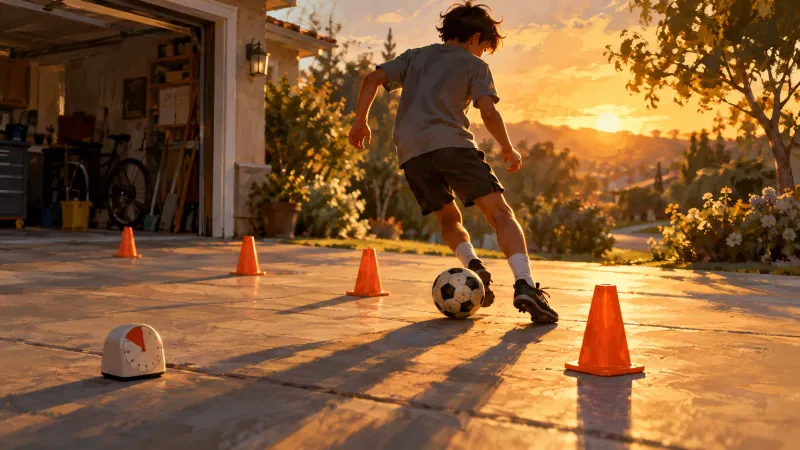
Here's a specific version you can run in a driveway or against any flat wall. Call it the two-target redirect. Set two cones, or two shoes, about four yards apart and about three yards out from the wall, one angled left and one angled right. Toss or kick the ball against the wall so it comes back at an angle. Your kid's job is to control it in one touch and redirect it cleanly toward whichever target you call out, calling it just before or as the ball leaves the wall. Score it by counting clean redirects, meaning the ball travels toward the target under control, in a 90-second round. Run three rounds and track the best one.
Twenty clean redirects in 90 seconds is a reasonable target for a 9- or 10-year-old who's never done the drill before. If your kid blows past that number for a few sessions in a row, move the cones out another yard or shorten the window to 60 seconds. If the number stalls for a week, move the cones in instead of adding pressure. The drill should get harder because your kid is better, not because you decided it should.
Keep the drill fixed for at least two weeks before you change anything about it. The point of repeating the same setup is that your kid stops thinking about the setup and starts thinking about the touch, which is the actual goal. Swap in a new drill every few days instead, and you reset that process before it has a chance to pay off.
A fixed assignment only works if your kid knows exactly what's expected and when it counts as done, each night. My post on getting your kid to practice soccer at home without nagging covers how to hand off a specific assignment like this one without it turning into a nightly argument.
How do you teach the first-touch decision, not just the technique?
Technique gets a ball under control. It doesn't tell a kid what to do with it, and that's the part most home drills skip entirely. My team uses a cue for exactly this moment, the instant we win the ball back: counter or comfort. One look. If a teammate is open forward, play it forward aggressively and everybody goes. If nothing's on, settle and possess instead of forcing it. The cue lives on the first touch itself, not two touches later, because the decision has to happen before the ball even fully stops.
You can build this into the two-target redirect without changing the setup. Instead of always calling a side, sometimes call "go," which means your kid plays the next touch forward as fast as possible toward either target, and sometimes call "hold," which means the next touch is a soft one that keeps the ball close and under control. Mixing the two forces a real decision on every rep instead of a reflex. A kid who redirects well but freezes when you call "go" hasn't learned the decision yet, only the mechanics.
Counter or comfort is one entry in a longer list of two-to-four word cues I use so kids remember them during a game instead of during a lecture. My post on how much a kid should practice soccer at home covers how I size a whole week of these home sessions, not just one drill.
How do you add scanning to a first-touch drill?
First touch and scanning are supposed to work together. The whole point of looking up before the ball arrives is knowing what you're going to do with your touch before it gets there, not after. If a kid scans well but still fumbles the touch, the information was wasted. If the touch is clean but the kid didn't look up first, the touch goes somewhere random, fast, and often straight to the nearest defender.
Add it to the two-target redirect by standing where your kid can't see you without turning, and holding up one or two fingers instead of pointing at a cone. One finger means the left target, two means the right. Your kid has to glance back before the ball arrives, read the number, and redirect toward that target in one touch. This forces the same head turn that shows up in a real game, right before a pass or a tackle arrives, instead of training the touch and the look as two separate skills that never connect.
Keep the session itself short. Fifteen to thirty minutes of this kind of ball mastery on non-practice days is enough, and even five to ten minutes makes a visible difference inside a couple of weeks. Longer than that and you're not building a skill anymore, you're testing patience, yours and your kid's both.
A structured first-touch session is exactly the kind of work that's easy to assign and easy to forget to check on. Train Daily gives your kid a short daily assignment with a video and a quick question to check what landed, so you're not the one standing over the stopwatch every night.
What to do this week
- Run the two-target redirect for one week before adding the scan call, so your kid locks in the mechanics first.
- Add "go" and "hold" calls once the redirect itself feels automatic, so the decision gets trained on top of the technique instead of before it.
- Track clean redirects per 90-second round, and only make the drill harder once that number stops moving for several sessions in a row.