How Youth Soccer Clubs Can Run a Shared Warm-Up for Multiple Teams
A soccer warm up for large groups works when one person owns it, every player has a ball, and the warm-up ends with a handoff to each team's coach. A club that runs its teams through one warm-up gets 40 players touching the ball from the first minute and one place to teach all of them at once.
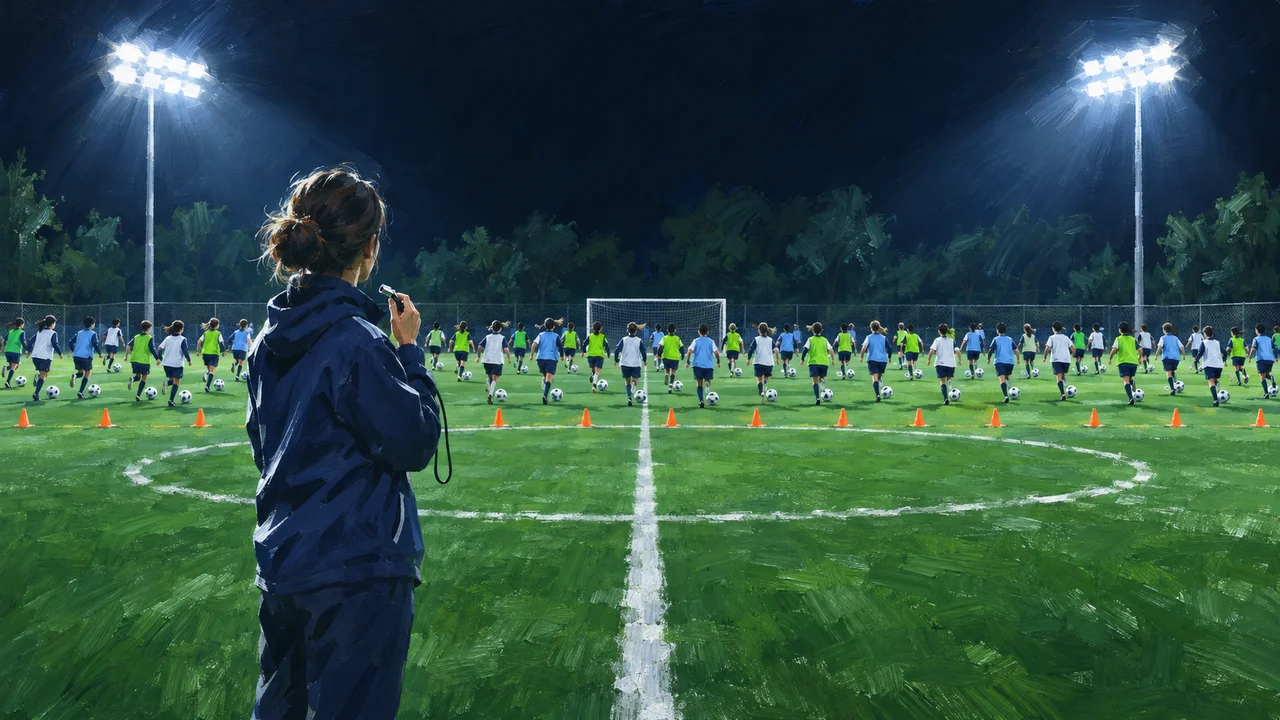
I co-founded Train Daily, and the program where I coach in Fort Wayne, IN, warms up its three 11U teams together before practice. That's about 40 players, one warm-up, and a short huddle before the teams split. A club can copy the setup with cones, a whistle, and one person willing to own it.
Why run one warm-up for multiple teams?
Our program groups players in three-year bands, 11U, 14U, and high school, and a player doesn't stay on one team for all three years. A nine-year-old on one of the lower teams can be on the top team the next season. Last season every team stayed in its own silo, so the first look a player got at the top team's habits came after the move up.
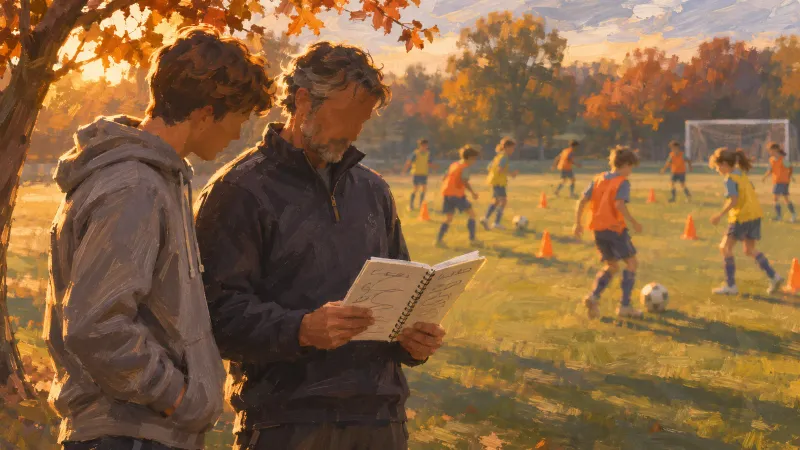
This year I wanted those players to know how the top team plays before they get there, so I share the warm-up and the huddle after it on purpose. All three teams hear the same cues, watch the same demonstration, and answer the same questions.
The same gap exists in any club where players move between teams inside an age band. A written curriculum for the whole club handles the paperwork side, and a shared block gives players a place to hear it.
What should a warm-up for 40 players look like?
Three rules keep a large-group warm-up from turning into a line. Every player has a ball, no player waits for a turn, and one person runs it with one voice. Our coordinators use everyone-has-a-ball juggling or lines of partner passing and skip the one giant circle, because a circle leaves too many players standing around.
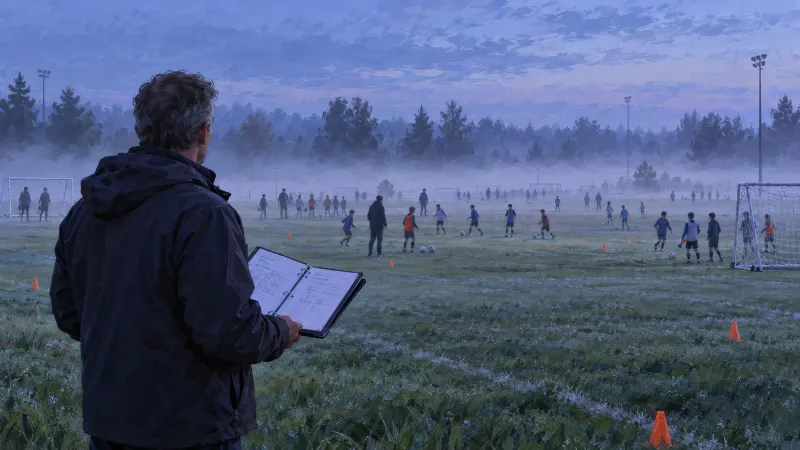
Our tryout plans opened their first three evenings with the same seven-trip sequence, and about 40 players ran it together. Players jog across a 50-yard width with a ball each and go a little faster on every trip.
- Across with both feet, using small, free touches.
- Back with the right foot only.
- Across with the left foot only.
- Back with inside, outside, outside, meaning the inside of one foot, then the outside of the other foot twice, then switch.
- Forward to halfway, delaying the ball back with the sole of the right foot.
- Forward to halfway again, delaying the ball back with the sole of the left foot.
- To halfway, then across with rollovers going left and back with rollovers going right, facing the same way the entire time.
Dynamic stretching and water close the sequence.
Tryout coaches had a second job during the trips. The plan told them to watch, and described the warm-up as "not a perfect evaluation, but an early indicator." On the third evening it also gave them a list of seven players to watch specifically.
The first evening ran on a tight clock. All three groups of players, called pods in our plan, heard a five-minute welcome talk together, ran about 18 minutes of warm-up and water, and then moved to separate grids with a pair of coaches each.
To run a sequence like this, mark the width with cones and stand where the whole line can see you. Call the next trip before the current one ends so players don't stop to wait for instructions. If 40 players don't fit on one line, send them in waves, and ask a second coach to walk behind the line and watch touch quality.
Who should run a shared warm-up, and for how long?
Name one owner. Our program's coordinators, Zach and Shelly Netherton, run one warm-up for all three teams, and it covers the first 23 to 25 minutes of a session. That's a stated cap, and 5 to 10 of those minutes are ball mastery so players touch the ball from the first minute.
The owner can only run what someone hands over. I give the coordinators the night's activity at the pre-practice briefing, and I hold one or two priorities for weeks instead of changing the trick every night, the same habit as picking one or two priorities per season. My example block is juggling with a scan call for a few weeks, then two-touch passing with a turn.
A scan call lets one warm-up train ball mastery and scanning together. A coach holds up fingers or calls colors during the touches, and players call out what they see. My post on drilling scanning with young players has the drills that follow it.
A shared warm-up covers the nights your teams meet. For the days with no coach on the field, Train Daily for coaches lets a coach assign the day's drill from a video library and see who finished it. It's free for coaches, players, and clubs, and you don't need a card to sign up.
What happens after the warm-up ends?
I lead a huddle with all three teams together. It has a theme for the day, a lesson or two, a demonstration, and a few questions. My plans give it three to five minutes, and it sits inside a water break.
On one Tuesday in late August the theme was defensive recovery and scanning without the ball. The plan had me ask "what phase are we in when they have it?" and wait for the answer. Then I demonstrated two things. One was a recovery sprint to get goal-side. The other was a defender whose head bounces between the ball and the player being marked. The cues were "Beaten? Sprint goal-side" and "Ball, then picture, then ball."
Then the teams split. Players take their water to their own areas, and each coach starts team-specific work. Ask assistants to set up each team's first activity while the warm-up runs so the split doesn't cost practice time.
The cues travel with the players. My plans have me repeat them at every water break, and a coach running a team block can use the same phrases. My post on how a club standardizes its cues covers how a director picks them.
What topics work for a combined huddle?
Pick a theme the whole program can use and keep it for the week. In our first week of practices the huddle covered the two phases of the game and three pressing triggers, each with a short cue ("Heavy touch, GO," "Back pass, GO," and "Slow pass, GO"). In phase one, everyone from the goalkeeper to the striker attacks or supports the attack. In phase two, everyone from the striker to the goalkeeper works to win the ball back.
Later weeks changed the theme and kept the structure. One huddle was scanning, with a demonstration of opening the body before the ball arrives and taking the first touch away from pressure. Another was defending, with a demonstration of the block tackle that leads with the front foot, locks the ankle, and bends the knee. Several huddles opened by reviewing the earlier themes, so the week-one cues kept coming back.
How often should teams train together beyond the warm-up?
Usually once a week, and the day changes. Some weeks it's Monday, some weeks it's Tuesday, and some weeks the teams share only the warm-up and the huddle.
On that Tuesday in late August, the combined block ran a 1v1 recovery exercise and then a 6v3 scanning overload. In the 1v1 exercise the attacker receives a short pass about 30 yards out and goes to goal while the defender runs behind a cone and has to get back goal-side. In the overload the three defenders are down three players, so they're forced to scan.
A combined block has a cost. On that Tuesday, team-specific work started about an hour into a two-hour practice. A director who copies this setup should decide how many nights a week to spend that hour on shared work.
How do you check that a shared warm-up and huddle are working?
Ask questions and listen. I keep asking "what phase are we in?" until players start asking it themselves. A coach can also listen for whether players from all three teams answer a huddle question in the same words.
What should a director set up before combining teams?
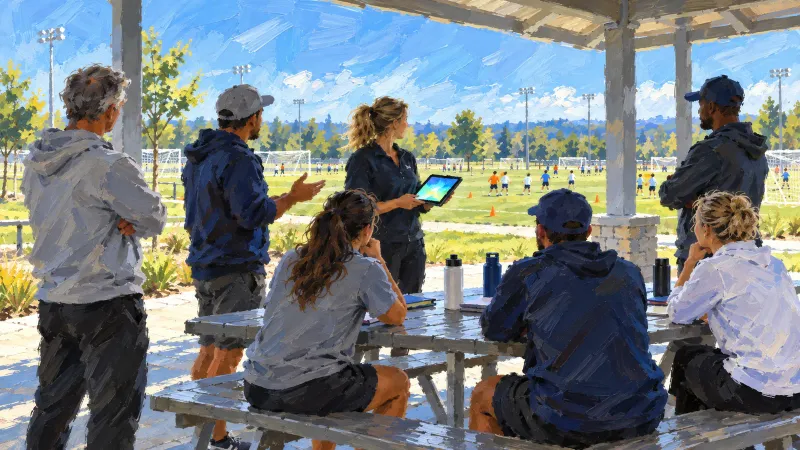
Give the warm-up owner and the huddle leader separate jobs. In our program the coordinators own the warm-up and I lead the huddle, so each block has one voice. Pick one huddle leader for a stretch of weeks.
Build a briefing into the week. I brief my assistants for 60 to 90 seconds the day before every practice and debrief for one to three minutes on the field afterward. The briefing is where the coordinators get the night's warm-up activity, and a director can set the same rhythm for whoever runs the shared block.
Check the practical limits early. A shared block needs a field wide enough for the group and an agreement with anyone else who uses the facility that night. Supervision ratios, background checks, and SafeSport requirements come from your governing body, and a combined group of 40 players raises the same questions as a single team. Confirm the details with your governing body and legal counsel before you combine rosters. This post isn't legal advice.
A shared warm-up standardizes the nights your teams meet. My post on off-day training across a whole club covers the days between. It lays out one assignment format, one visible record, and one owner at the club level.
What to do this week
- Name one owner for the warm-up and give that person the night's activity before practice.
- Write the warm-up sequence down, with a ball at every player's feet, so the owner can run it without you.
- Pick one coach to lead a three-to-five minute huddle after it, and have each team take its water to its own area when it ends.
- Give the days between shared nights something to do, such as a daily assignment through Train Daily for coaches.
Frequently asked questions
How long should a shared soccer warm-up be?
Ours has a stated cap of 23 to 25 minutes, and 5 to 10 of those minutes are ball mastery. Pick a cap for your own program and hold to it, because a shared block that runs long eats the time each coach needs for team-specific work.
How many players can one warm-up handle?
Ours handles about 40 players from three teams, with a ball at every player's feet. Every trip in the tryout sequence is a straight run across a set width, so players don't wait for a turn. Mark the width with cones before players arrive, and send players in waves if one line gets crowded.
Who should lead the huddle after a shared warm-up?
One coach for a stretch of weeks. In our program the coordinators run the warm-up and I lead the huddle with all three teams. The leader brings a theme for the day, a lesson or two, a demonstration, and a few questions, then sends the teams to their own areas.
Does a shared warm-up replace off-day training?
No. The ball mastery opener adds touches at practice, and it doesn't replace off-day work on the days with no coach on the field. My team plan is 15 to 30 minutes of ball mastery on non-practice days, and that number is mine, not a rule.