When Should Kids Start Using Their Weak Foot in Soccer?
Start weak-foot work as soon as your kid can already pass, receive, and dribble reasonably well with their strong foot, usually around age 7 or 8. Weak-foot training isn't a stage you wait for and then switch on. It runs alongside every other skill from the first season, in small, specific reps rather than one big push later.
I co-founded Train Daily and coach in Fort Wayne, IN. Parents ask me this one constantly, usually right after watching their kid's left foot do nothing but stand there during a game. When do we start making the weak foot do something?
The short version is that there's no separate starting line. A player who can already control, pass, and receive comfortably with their strong foot is ready to start layering in the weak foot, and that readiness shows up for most players somewhere in the 7 to 8 range. Waiting for some later, more "serious" age just means more years of a dominant foot doing all the work and a weak foot getting worse by comparison.
When should kids start working on their weak foot?
As soon as the strong foot already handles the basics. That means a pass that gets there, a first touch that doesn't bounce six feet away, a simple dribble around a cone without losing the ball.
That's a skill threshold more than a specific birthday, so it looks different kid to kid. Some players hit it at 6. Others aren't ready until 9. The real mistake is treating weak-foot work as something you bolt on later instead of something that runs in parallel from the start.
Watch for a few concrete signs instead of guessing at an age. Your kid can receive a rolling pass without it bouncing off their foot. They can dribble a few yards in a straight line without stopping to reset. They can pass to a target five or ten yards away and get it there most of the time. Once the strong foot clears that bar, the weak foot doesn't need to wait around for anything else.
Why does training the weak foot matter this early?
Because a good first touch creates time, and a bad one takes it away. When a touch is automatic, whichever foot takes it, a player's brain is free to scan the field and make a decision instead of just managing the ball.
Anson Dorrance's program at UNC builds first touch through six core moves, inside and outside the foot, both feet, repeated constantly until they stop requiring thought. The point was never the moves themselves. It's freeing up the mental space that touch control eats up when it isn't automatic yet.
Mia Hamm said of her former teammate Kristine Lilly that she "mastered the ordinary, and that made her extraordinary." An inside cut, an outside cut, a change of direction done the same clean way thousands of times, on both feet, is what separates a player who looks comfortable on the ball from one who doesn't. None of it is a trick. It's repetition, split evenly between both feet instead of loaded almost entirely onto one.
You can see the gap show up in a real game, not just in a drill. A player who only trusts one foot tends to give away which direction they're going before the defender even has to guess, because the ball usually gets shuffled onto the strong side first. A player who's comfortable on both feet can turn either way, and that alone buys a half-second a one-footed player rarely gets. Defenders read hesitation and favored feet quickly, even at nine and ten years old.
If your kid's first touch is still the thing breaking down most often, this piece on building a reliable first touch walks through the same Dorrance-based approach in more detail, including which six moves to start with.
What's a simple way to practice weak-foot touches at home?
Keep it specific and countable, not vague. "Work on your weak foot" doesn't give a kid anything to actually do. "50 inside-foot passes with your left foot against a wall in 10 minutes" does.
That's the exact format I use with my own team on off days. Fifteen to thirty minutes, ball mastery only, no fitness work mixed in, and every assignment is a number and a time limit instead of an open-ended suggestion. For the first week or two, I give every player on the roster the identical assignment, weak foot included, so the habit of showing up and doing the reps forms before anything gets personalized to what one specific kid needs.
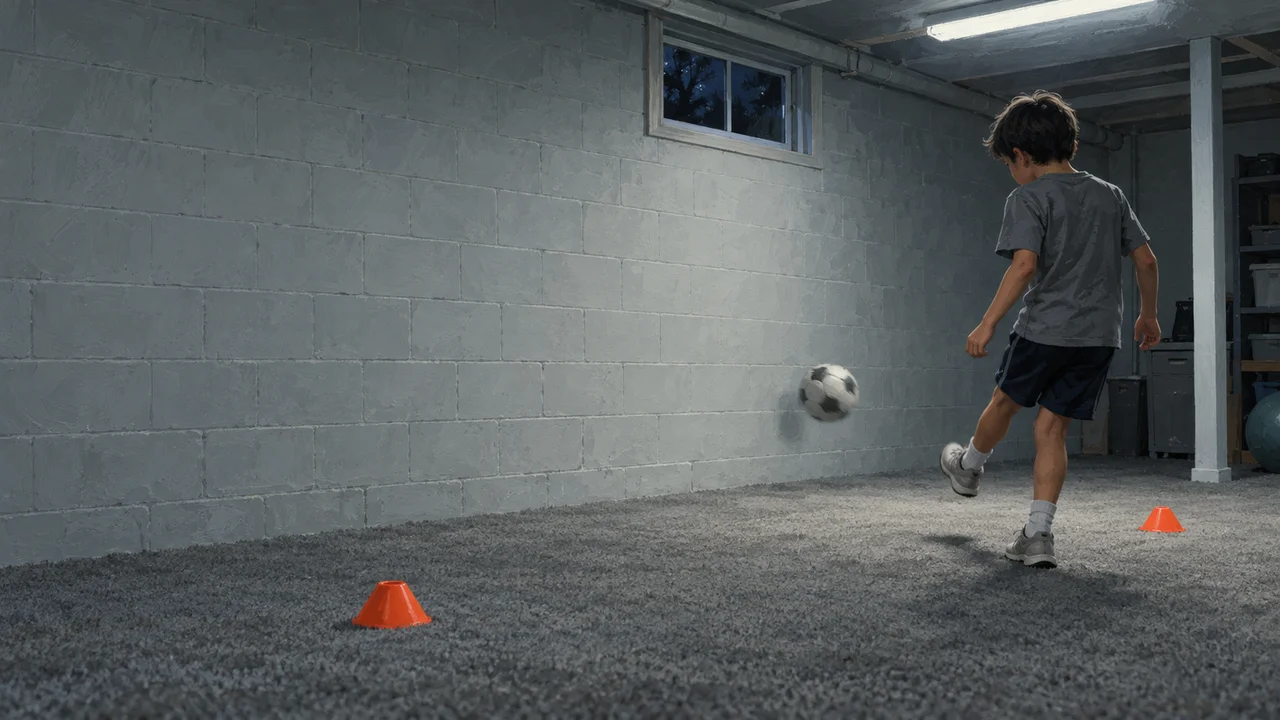
A wall, a driveway, or a sibling with a spare ball is enough equipment. The number is the constraint that actually matters, not the setup.
Should you force your kid to use only their weak foot?
Not as a standing rule, and I say that from direct experience talking myself out of a gimmick. I looked at putting a different colored sock on a player's weak foot to flag it, with the matching pair earned back once it improved. I decided against it. Weak-foot development still gets the same priority as every other skill on the team. It just runs through the same ball mastery reps and off-day work as everything else, not a separate mechanic that singles one foot out as the problem.
The reps matter more than the label. A kid doing 50 countable touches a day on the weak foot is getting more out of it than a kid wearing a mismatched sock and feeling self-conscious about which foot is "bad."
What if your kid refuses to use their weak foot in games?
That's normal, and it isn't a game-day problem. Under pressure, a player reverts to whatever foot already feels automatic. Forcing weak-foot touches live, in a real game, usually just produces a turnover and a frustrated kid.
The fix happens off the ball and before kickoff. Reps accumulate at home and in practice until the weak foot stops feeling like a separate decision. One trick coaches use inside small-sided practice games is a touch constraint, a stretch of play where every touch has to be with the weak foot, applied to the whole group rather than singling out one player. It works because nobody's foot gets called out. Everyone's working the same constraint at the same time.
Your kid using the weak foot in an actual game is the last step, not the first one. It shows up once the reps at home catch up.
Does weak-foot work mean less time on the strong foot?
No, and that's a common misread. Weak-foot work is additive, not a swap. A balanced split, roughly even time on each foot during ball mastery work, builds a more complete player than either loading everything onto the strong foot or overcorrecting so hard toward the weak one that the strong foot stalls out.
Think of it less as two separate training tracks and more as one habit applied twice. The same wall, the same counted reps, the same short daily window, just alternating which foot is doing the work. A kid doing 50 reps on the strong foot and 50 on the weak one in the same ten-minute session is building the same skill on both sides of their body, not splitting their effort between two different ones.
How Train Daily fits into weak-foot practice
This is exactly the gap Train Daily is built to close. Instead of a vague "work on your weak foot" text from a coach, your kid opens the app, sees a specific assigned rep count for the day, watches the drill video, and taps it done. The streak and the points are what keep a kid coming back to a wall drill on a Tuesday when nobody's watching.
A parent account on Train Daily gets reps auto-assigned by your kid's age and focus area, weak foot included, so you're not the one deciding what the drill of the day should be.
Your kid doesn't need a mismatched pair of socks to know which foot needs the work. They need a specific number, a short timer, and a reason to come back tomorrow.
Frequently asked questions
At what age should a kid start weak-foot training in soccer?
Most players are ready once their strong foot already handles basic passing, receiving, and dribbling, which tends to land somewhere around age 7 or 8. It's a skill threshold rather than a fixed age, so a player who's further along can start sooner and one who's still working on strong-foot basics can wait without falling behind.
Is it a problem if my kid still avoids their weak foot at age 10 or 11?
It's common, not a red flag on its own. A weak foot that's years behind the strong one usually means it hasn't gotten dedicated reps yet, not that something's wrong. Specific, countable off-day work, even just 10 minutes a day, closes that gap faster than most parents expect.
How many weak-foot reps does a kid actually need per day?
There's no single magic number, but a specific, countable target beats an open-ended one. Something like 50 inside-foot passes against a wall in 10 minutes gives a kid a clear finish line. Daily, short sessions on non-practice days add up faster than occasional long ones.
Should coaches require weak-foot-only play during games?
Rarely as a blanket rule in competitive games, since forcing it live usually just costs a turnover. It works better as a constraint inside a small-sided practice game, applied to the whole group, so every player is working the same restriction instead of one kid being singled out.
What's the best weak-foot drill to do at home with no equipment?
A wall and a ball cover most of it. Inside-foot passes against a wall, counted reps in a timed window, build the same automaticity that cone work does, without needing a yard full of equipment. The drill matters less than making it specific and counted instead of open-ended.