Soccer Skills for an 11-Year-Old: What They Should Do and Practice at Home
Soccer skills for an 11-year-old come down to passing short and long with both feet, receiving the ball under pressure, and combining with a teammate. Below is what to practice at home, what daily reps looked like for two players on my roster, and what changes when the field opens up to 11v11.
I co-founded Train Daily and coach an 11U team in Fort Wayne, IN, so 11-year-olds are the age I watch most closely. My roster runs from 9 to 11 and plays 9v9, so my oldest players are about two years from the 11v11 game. The technical list barely changes from age 10. The game around it does, because passes get longer and defenders close faster, and a player who can only pass short with one foot runs out of options.
What soccer skills should an 11-year-old have?
An 11-year-old should be able to pass short and long with both feet, receive the ball under moderate pressure with a first touch that sets up the next action, and combine with one or two teammates in a give-and-go or a 2v1. U.S. Soccer's coaching guide for U11 and U12 lists the same focus areas for coaches, and I checked that page on November 6, 2026.
Each skill builds on earlier work. Weak-foot comfort is the same gap I see at 9 and 10, and my post on building a weak foot covers how to close it. If your son or daughter still avoids one foot in games, fix that before you add anything new.
Younger players get a younger version of this list. I wrote the same guide for what a 9-year-old should be working on and for what a 10-year-old can practice at home, and the two-phase framework and pressing triggers in the 10-year-old guide carry over to this age.
What do 11-year-olds play, and what changes at 13?
U.S. Soccer lists 9v9 as the maximum game format for U11 and U12, and 11v11 as the maximum for U13 and older, according to its game formats page as of November 6, 2026. Because 9v9 is a maximum, some leagues use smaller games, so ask your club what your child's league plays.
The jump to 11v11 adds two players per side and a bigger field. That means more space between the lines, longer passes to switch the ball from one side to the other, and more ground to cover when your team doesn't have it. An 11-year-old who can hit a driven pass with either foot and glance over a shoulder before the ball arrives has built what the bigger game asks for.
My team got an early look at it this fall. Because of what one opponent could field, we played 11v11 on a field only 10 to 20% bigger than our 9v9 field, and we won 9-1 against Lakewood Park, a team that had beaten us 3-1 the year before. Eleven players on that small field rewarded quick passing over dribbling, which is why I'd put short passing at the top of your home list, with long passing right behind it.
How can an 11-year-old practice passing short and long at home?
Start with a wall for short passes, add a partner or a target for long ones, and attach a number to every set so your child knows when they're done. A finish line matters more than a perfect session.
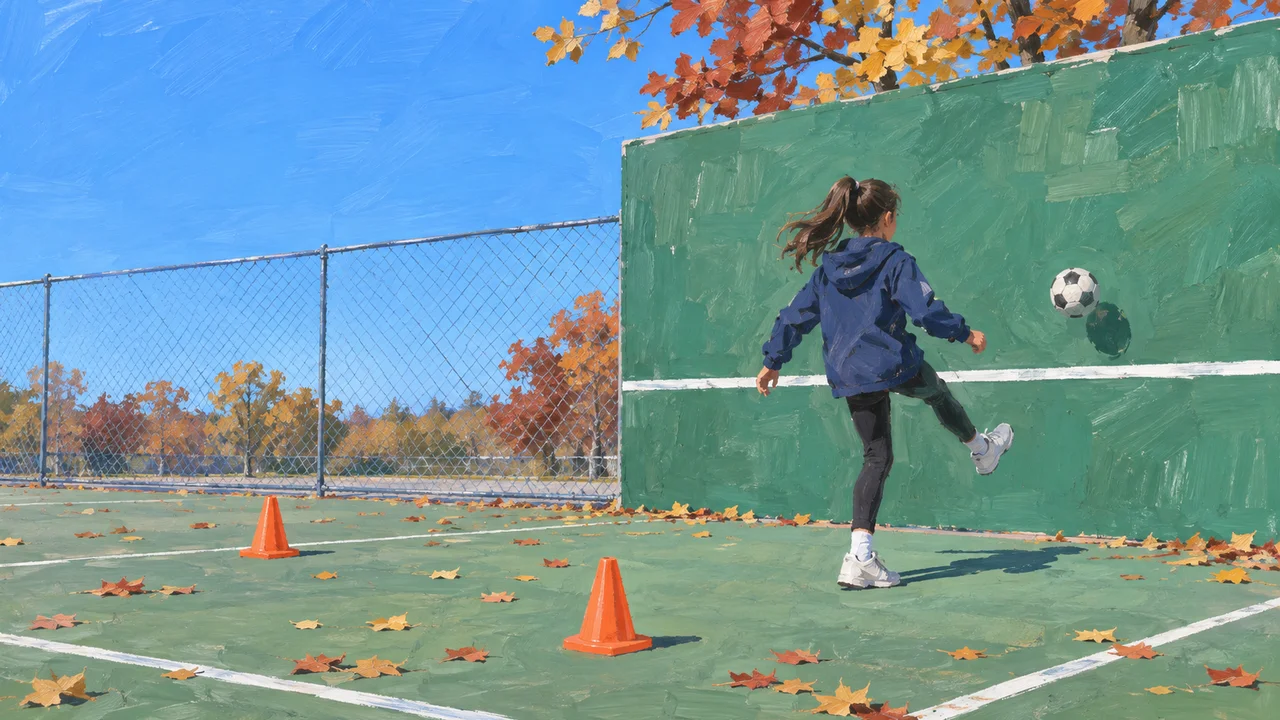
- For short passes, stand five yards from a wall and pass with the inside of the foot, using both feet. On my team the assignment reads "50 inside-foot passes with your left against the wall in 10 minutes," because a count and a clock give a player something to beat tomorrow.
- For long passes, pick a target far enough away that the pass takes a full swing, such as a cone, a tree, or a parent standing in the yard. Hit 10 with each foot and count how many land within a few yards of the target.
- To combine them, play five wall passes, then one long pass to the target, and repeat. Real games ask for both in the same minute.
For the long pass, plant the non-kicking foot beside the ball and point it at the target. Lock the ankle, strike through the ball, and follow through toward where you want it to go. A lofted pass comes from striking lower on the ball, and an 11-year-old can learn the difference by trying both and watching what the ball does.
You can be the target without knowing the game. Stand where the cone would be and tell your child how close the pass landed. My post on ways to help from the yard when you don't know the game has more. If you want the exact wording for a countable assignment, my post on writing a practice assignment your child will finish walks through it.
How does an 11-year-old practice receiving the ball under pressure?
Add a defender, even a walking one. Receiving under pressure means the first touch happens with someone closing in, so the drill needs someone closing in.
Stand 10 yards from your child and pass the ball. As it travels, start walking toward them. Your child takes the first touch away from you into open space and passes it back. Once that feels easy, jog instead of walk. Set two cones of different colors a few yards apart behind your child, and call a color while the pass is still on its way. Your child checks over a shoulder, finds that cone, and takes the first touch toward it.
That shoulder check is the cue I use with my team from the first practice, "picture, then ball." The player takes a picture of the field before the ball arrives, so the touch has somewhere to go.
If your child's first touch still stops the ball dead instead of setting up the next move, my post on improving a first touch at home has driveway drills for it. It also covers how to add scanning to a first-touch drill.
How can an 11-year-old practice combination play at home?
Treat the wall as the teammate. Pass into the wall at an angle, sprint past a cone placed to one side as if you're beating a defender, and take the return pass on the move. That is a give-and-go, and an 11-year-old can run 20 of them in five minutes with no one else in the yard.
With a parent, the wall becomes the second attacker in a 2v1. Your child plays against you, and the wall is their partner. You defend at walking speed and your child tries to beat you by passing into the wall and running onto the return. Speed up as your child starts winning more often than not. U.S. Soccer's guide for this age names 2v1 situations as a coaching focus, so it's worth starting now.
What did daily reps look like for two players on my roster?
Both players below are on my 11U roster, so they're 10 or 11. Each one showed up to tryouts as a different player than the year before, and each was among the heaviest daily users of Train Daily on the team.
The first is the most improved player on my team from last season to this one, a boy I wasn't sure would make the roster this year. I could tell on the first day of tryouts that he was a different player. He also did more Train Daily than anyone on the roster, won every challenge, and never missed a day. His first touch, his ball control, and his confidence were off the charts, and he became our lockdown center back and one of our top five players.
The second is a girl who didn't make the roster the year before. She ranked around 18th or 19th in a tryout where I took 11 players, so it wasn't close. This year her footwork was about 100 times better and her ball control was night and day from the previous tryout. I could tell inside the first 10 minutes. She made the roster and has been a valuable player for us, and she was one of the top five Train Daily users among the roughly 30 players who came to tryouts and used the app.
In the two weeks before this season, 13 of my players used Train Daily, and on day one their touch was well ahead of the same team a year earlier. Players grow and improve for plenty of reasons, and results depend on the player. What I can report is what showed up on the field, which was first touch and ball control, the same skills this post covers.
The plan behind those numbers is small. On my team, non-practice days get 15 to 30 minutes of ball mastery. The first two weeks all my players get identical work so the habit forms before the work personalizes. Assignments are countable, like the wall passes above.
If you want your 11-year-old to have daily reps without writing the plan yourself, Train Daily for parents assigns age-matched reps with a video for each drill. Train Daily is free to use, and no card is required.
What should you do when your 11-year-old wants less of you at practice?
Offer choices and ask before you coach. U.S. Soccer's guide describes players at this age as wanting more independence from their parents, with emotions that can change quickly (page checked November 6, 2026). An 11-year-old whose parent corrects from the driveway after each rep often stops going out to the driveway.
Give your child two assignments and let them pick which goes first. After a set, ask "want a tip?" and accept a no. On my team I make contact with a player, acknowledge what they tried, ask if they want feedback, and only then give it. Once your child says yes, give one tip, not four.
Then walk away. Set up the target, tell your child the count and the clock, and go inside. A player who finishes an assignment alone gets a different kind of confidence than one who finishes it with you watching.
How much should an 11-year-old practice at home?
On days without team practice, 15 to 30 minutes of ball mastery is my team's plan, and that number is mine, not a research finding. Fifteen minutes that your child finishes beats 45 minutes they dread. My longer post on how much practice a player needs between team sessions goes through how to tell if the length is right.
A habit survives a busy week when the ask is small and the streak is visible. My post on why I start my players on the same daily assignment covers how that works.
What to do this week
- Pick one wall assignment with a count and a clock, such as 50 inside-foot passes with the weaker foot in 10 minutes, and repeat it for two weeks before you change it.
- Add 10 long passes with each foot to a target on three days, and count how many land close.
- Run the walking-defender receiving drill twice, and call a cone color while the pass is still traveling.