9v9 Soccer Practice Plan for Youth Soccer Coaches
A 9v9 soccer practice plan needs three things most generic templates skip: a warm-up that puts players on the ball from the first minute, an exercise bank sized for the bigger field and the extra numbers, and an honest list of what each drill in that bank still doesn't teach. Here's the plan I use with a 9v9 roster, block by block, and the one gap I haven't built yet.
I co-founded Train Daily and coach an 11U team in Fort Wayne, IN that plays 9v9, three practices a week. A 9v9 soccer practice plan isn't a 7v7 session with two extra bodies stapled on. The field is wider and longer, there are two center backs instead of one, and a drill that worked fine at 7v7 can leave half your roster standing around once you add the numbers. Here's how I build a full 9v9 session: the warm-up, the bank of exercises I actually use, and what each one still doesn't cover.
What should a 9v9 soccer practice actually include?
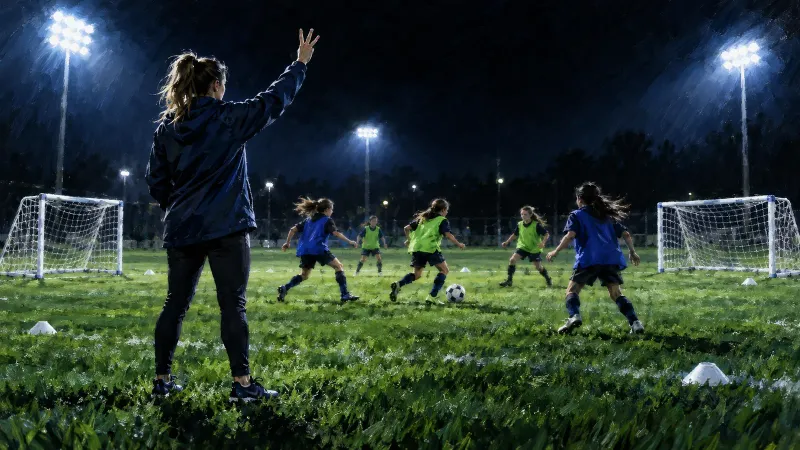
A 9v9 practice should run on US Soccer's Play-Practice-Play structure: small games first, a game-like practice phase in the middle, then a bigger scrimmage to close. I keep at least 85% of that time in environments where attack, defense, and transition all show up at once, rather than isolated attacking or defending drills. The remaining 10 to 15% goes to ball mastery, which lines up with Coerver's own recommendation from the other direction.
At 9v9, the practice phase needs more from the exercise bank than it does at 7v7. A smaller field format can get away with three or four core exercises because the games themselves cover more ground. At 9v9, with two extra field players and a bigger box to defend, I lean on a bank of seven confirmed exercises and I'm still building toward the roughly 15 I'm targeting for the season.
I've written about the planning philosophy behind Play-Practice-Play elsewhere. This post is the 9v9-specific piece: the bank itself, what each entry teaches and doesn't, and how I lay the blocks out over a full session.
For the full planning framework behind this session, including how I decide what to teach and how I fix a drill when one side keeps winning, How to Plan a Youth Soccer Practice covers the philosophy this post builds on.
How should the warm-up work for a 9v9 roster?
Open with the ball on their feet, not with running laps. Running laps is a great way to get the blood flowing but does nothing for their touch or ball mastery. This is a lesson I learned from Landon Donovan, who said a coach always had a ball at their feet during warmups.
My program runs this warm-up across three 9v9 teams and about 40 players, so it has to scale with almost no setup. Everyone-has-a-ball juggling or lines of partner passing work. One giant circle doesn't, because it leaves too many kids waiting their turn. We fold a 5 to 10 minute ball mastery opener into that same warm-up so players touch the ball from minute one instead of standing around, and the whole window runs 15 minutes, an intentional cap, not drift. Scanning gets layered on top whenever we can: a coach holds up fingers or calls colors during the touches, and players call out what they see before the next one arrives.
Hold one or two priorities for weeks instead of a new wrinkle every night. We've run "juggling with a scan call" for a stretch, then moved to "two-touch passing with a turn." A 9v9 roster is big enough that a new instruction every night means half the group never actually absorbs it before you've moved on.
What's in a 9v9 exercise bank, and what does each drill actually teach?
Every exercise in the bank earns its spot by doing something specific, and every exercise has a list of what it can't do. Writing that second list down matters as much as building the first one, because it tells you what you still owe your players somewhere else in the week.
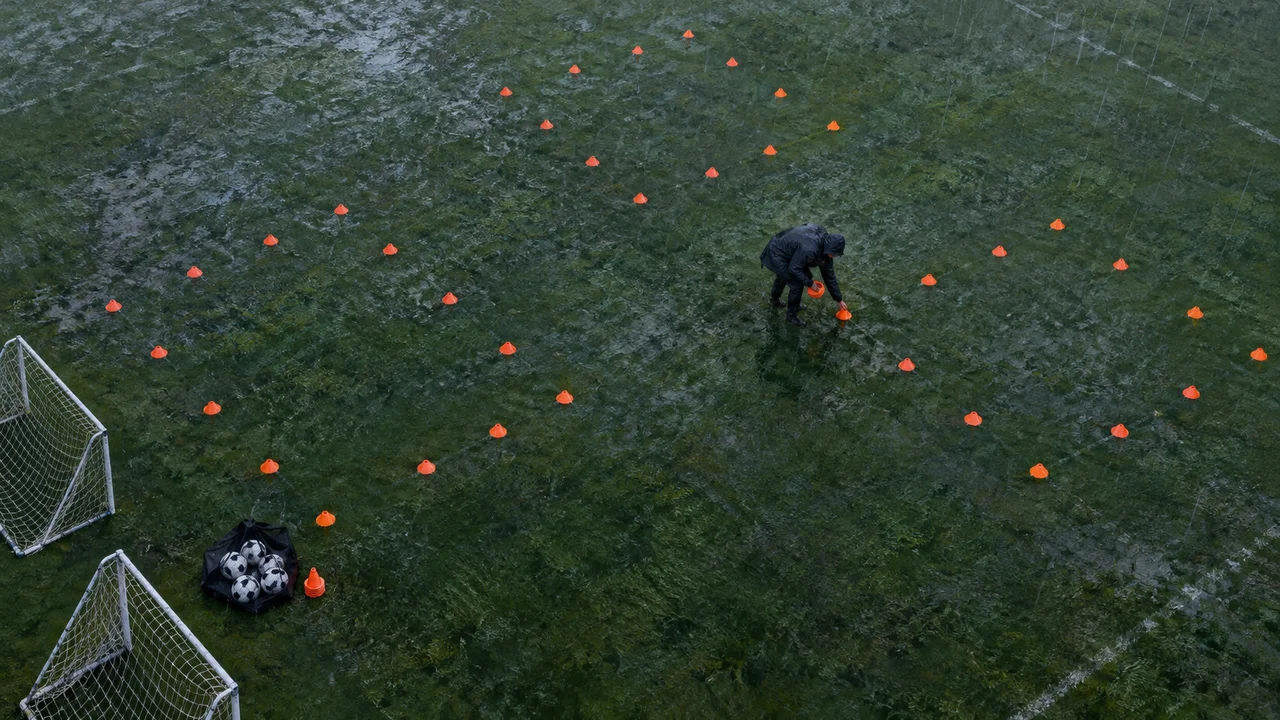
Open Cone. One cone circle, six or seven cones at varying distances with one cone in the middle. Players pass, then sprint to the open cone, and the ball never stops. Scoring is simple: most consecutive passes earns the point, counted out loud, reset on a turnover. It teaches scanning that ends in a decision and support positioning, but it can't teach anything involving an opponent, and the pattern has to stay unpredictable or the scanning demand disappears.
Moving Open Cone. The same setup, except players progress from one cone group to the next after five clean passes. A mistake before everyone reaches a segment sends the whole group back; a mistake after everyone's arrived just holds them there. At the final segment, five or more passes earn a shot on a small goal. The first time we ran it, the group finished 22 to 21, with the best ball movement of the season to that point. It adds real conditioning on top of the scanning demand, since players are sprinting 5 to 25 yards every 5 to 20 seconds, but it still can't teach any kind of defending or finishing under pressure.
5v5 to small goals. A standard small-sided game, no keepers, winner earns the point. This is the one I use to open the practice phase, because I say almost nothing and just watch for what needs coaching later. It covers attack, defense, and transition all at once, which alone satisfies the 85% rule, but it can't teach box defending, crossing, goalkeeper decisions, or set pieces.
5v5 to large goals. A shortened field, both teams defending a full goal with a keeper. This is the one I weight heaviest when it closes the session, since it's the closest thing to a real game inside practice. It needs two full goals, so confirm field space before you plan around it. It teaches realistic finishing and keeper decision-making, but it can't teach full-field spacing or long-ball defending, since the field is shorter than a real 9v9 game.
I've already written up through balls and cutbacks and beat the sprint in detail elsewhere, including the exact scoring systems that make them work. Both earn a permanent spot in a 9v9 bank: through balls and cutbacks forces players to time runs into space instead of dribbling at defenders, and beat the sprint trains the habit of sprinting goal-side the instant you're beaten. Neither one teaches build-up play or box defending, which is why they sit alongside the rest of the bank instead of replacing it.
Corners, live. A full attacking setup with a keeper and three defenders marking, rotating every four or five reps. Attackers score 1 for a shot on frame, 2 for a goal. Defenders score 1 for any clearance that goes wide and past the 18, and play stays live for eight seconds after every rep so the deep center back has to make a real counter-cover decision. It teaches set-piece execution and the transition that follows one, but it can't teach anything from open play, and it's positional rather than personnel-based, so rotate every player through near post, far post, and the chaos group so the setup survives whoever's on the field that night.
Any one of these exercises can drop straight into a scored, team-vs-team format and change the entire energy of the night. Youth soccer coaches: does competition between teammates help or hurt? covers the format I run once a week, where engagement ran near 100% for two hours and every player logged over a thousand touches.
How do you lay out a full 9v9 practice block by block?
Build the night in the same Play-Practice-Play order every time, and let the exercise bank fill the middle. A typical two-hour 9v9 session looks like this: 15 minutes of warm-up with the ball mastery and scanning overlay, 15 to 20 minutes of a 5v5 or 6v6 small-sided game to open the practice phase, 20 to 25 minutes of one bank exercise tied to that night's theme, another block if the theme needs a second rep at a different numbers advantage, and a final game that runs the rest of the clock and counts for more points than anything before it.
Repeat the core exercises across the week instead of swapping in something new every night. Chris Ramsey's rule of thumb is that players absorb about 30% of a session the first time, 60% the second, and more on the third, so the same block with small variations across two sessions beats two completely different sessions that never get mastered.
Water breaks matter more at 9v9 than at a smaller format, simply because there are more bodies covering more ground. I use every break to restate that night's priority out loud, since a reminder at the water jug lands better than a lecture at the start of practice that nobody remembers by the second block.
What's still missing from a 9v9 practice plan?
The bank above is weighted toward possession, scanning, and attacking, and two items stay unbuilt. Defending the long ball, both the kick-and-chase over the top and the opposing keeper's punt that your own keeper has to clear, has never gotten a dedicated block. Finishing and final-third attacking as its own standalone exercise is the other gap. Both are real holes in a 9v9 bank, not hidden ones, and neither should get bolted on as new architecture in the middle of a game week just to say the bank is complete.
Name your own gaps the same way. A 9v9 roster covers more ground than a 7v7 one, which means the long-ball problem shows up sooner than most new 9v9 coaches expect. Write down what your bank can't teach yet, the same way you write down what each individual drill can't teach, and you'll know exactly what to build next instead of discovering it live during a game.
What to do this week
- Pick two or three exercises from the bank above that fit your roster size, and run them for two straight sessions before swapping anything out.
- Write down what each exercise in your own bank can't teach, so you know what you still owe your players somewhere else in the week.
- Name one gap in your bank, such as defending the long ball, and plan to build it deliberately instead of patching it mid-game.
Between-practice work matters just as much as what happens inside the two hours above. Train Daily for coaches lets you assign a drill from a video library in about two minutes a day and see who actually did the work before the next session.