How Youth Soccer Coaches Can Plan a Practice With Play-Practice-Play
Not sure how to plan a soccer practice that isn't a pile of cones and hope? Use U.S. Soccer's Play-Practice-Play: small games when players arrive, a game-like practice phase, and a closing scrimmage. I run every two-hour practice that way, and the closing scrimmage tells me whether the night's lesson landed.
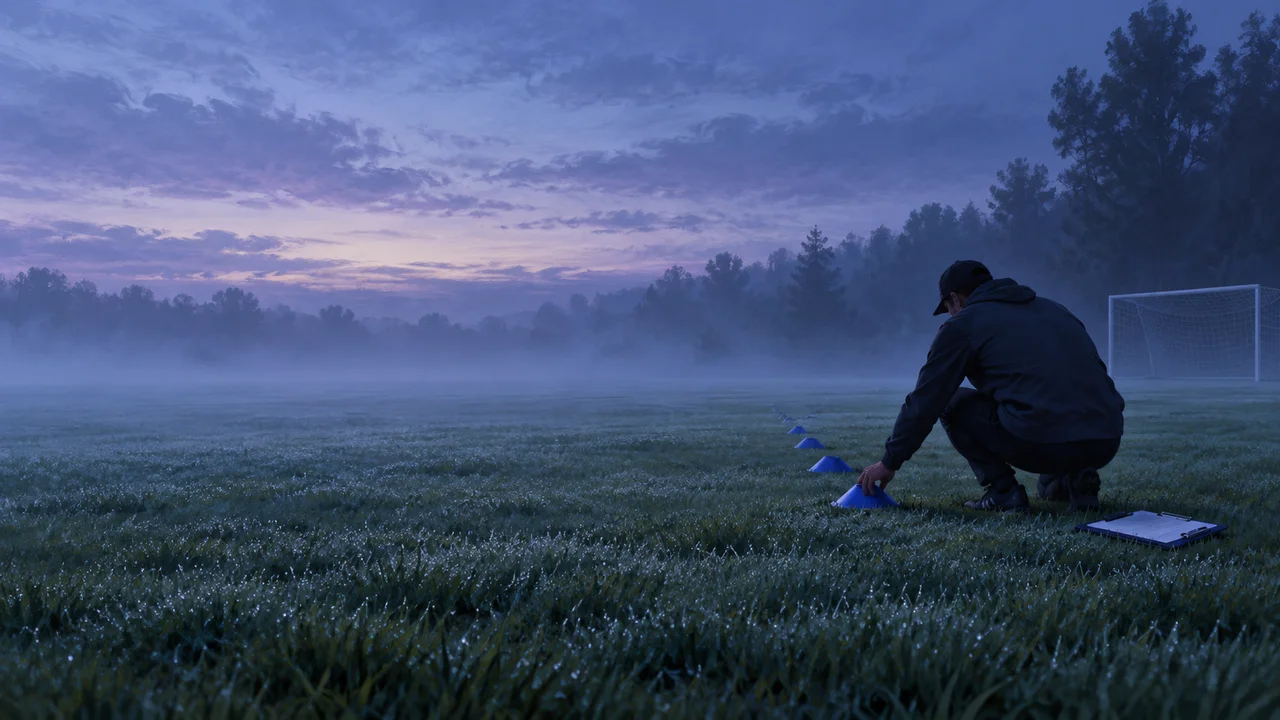
I'm Matt McWilliams, head coach of an 11U A team and co-founder of Train Daily. I never played soccer, so everything I know about session design came from U.S. Soccer's materials, podcasts, and long interviews with coaches. Yes, I'm the guy with the clipboard.
The framework details below come from U.S. Soccer's own documents, which I checked on October 1, 2026. The examples come from my team.
What is Play-Practice-Play?
Play-Practice-Play is a U.S. Soccer grassroots framework that organizes a session into three phases: small-sided games, a game-like practice phase, and a final scrimmage. U.S. Soccer describes it in "Five Things to Know About Play-Practice-Play" (February 27, 2018) as a player-centered approach that lets young players experience the game as much as possible.
It differs from sessions built on lines, laps, and drills that don't resemble the game.
U.S. Soccer's Play-Practice-Play overview adds five questions to ask about any activity: is it organized, game-like, repetitive, challenging, and well coached? An activity that fails one of them needs a change before you run it.
How do you start a soccer practice?
Start with small games, and let players play the moment they arrive. U.S. Soccer's overview has players begin in 2v2, 3v3, or 4v4 games (or unequal numbers, depending on who shows up). The coach's job in this phase is to welcome players, keep them safe, and observe, using positive specific praise, key words, and guided questions.
My version has one change. My program runs a shared warm-up first, so my first play phase comes after it. On September 8, 2026, I ran a 5v5 and 6v6 game to small goals on a small field for 20 minutes, with no keepers and a point for the winner.
I said almost nothing, which is harder than it sounds. A small field forces more touches and faster decisions, and I watched for two things: scanning before receiving and recovering goal-side.
What goes in the practice phase?
The practice phase is a game-like activity with a direction, set in the part of the field that matches the session goal. U.S. Soccer's overview gives every activity three challenge levels: Core, Less Challenging, and More Challenging. You start with the core version and move up or down until the challenge fits your players.
Here is how I build levels into one exercise. In "through balls and cutbacks," one team attacks a full goal against defenders. The first half of the block is 3v2, and the second half is 2v1. Each team gets 16 counted attacks, and extras rotate in so nobody stands out more than two reps.
The scoring decides what players learn. A goal off a through ball or cutback is worth 3, any other goal is worth 1, and the defending team earns 1 for winning the ball or forcing it wide. Without the 3-point bonus, players dribble at defenders because it works.
Another exercise, "beat the sprint," uses distance as the challenge lever.
A defender must touch a cone behind him before chasing, so he recovers from behind. If defenders get beaten every rep, I move the cone to 3 yards. If attackers never score, I push it to 8. I change the cone and leave the coaching alone.
How do you end a soccer practice?
End with a scrimmage that has larger numbers and few interruptions. U.S. Soccer's overview says the coach's main job in this second play phase is to check how well the earlier teaching worked, with a half-time built in so players can reflect and look for solutions.
That second play phase is my retrieval window every night. On September 8, 2026, the final game was 5v5 and 6v6 on a half field to full-size goals, with a keeper on each side and a bigger point value than any earlier block. I announced the weight before kickoff so players knew what was on the line.
If a lesson didn't land, I see it here. Players who understood the night's idea show it in the scrimmage, and players who didn't revert to old habits. I use what I see to decide what to repeat.
How do you pick what to teach in one practice?
Pick one theme from attacking, defending, or transition. U.S. Soccer lists attacking and defending session goals separately, such as building up from your own half or preventing the opponent from scoring.
Then choose how you'll teach it: discovery (you stay quiet and observe), engagement (you're present and affirming), or direct instruction (you teach one specific thing). Pick one so you don't drift between all three.
I keep at least 85% of session time in environments where attack, defense, and transition all show up. Isolated drills use the remaining time. I coach whichever of the three is the day's theme.
Kristine Lilly has said she watches a game, sees six problems she wants to fix, and then teaches nothing well. I took that as a warning. I pick one or two things for the season and teach those well, even though I find new fix-its after every game.
What does a two-hour practice look like?
Here is the September 8, 2026 plan from my team. The two teams stayed locked for the whole night, and every block scored toward one running total.
- Warm-up, 20 minutes: the shared program warm-up, with ball mastery and a scanning layer.
- Game 1, 20 minutes: 5v5 or 6v6 to small goals on a small field.
- Moving Open Cone, 20 minutes: passing and moving to the open cone, with segments that send the group back or hold it in place after a mistake.
- Through balls and cutbacks, 25 minutes: 3v2, then 2v1, with the 3-point bonus.
- Final game, the rest of the practice: 5v5 or 6v6 on a half field to full goals.
I stop for water between blocks and repeat the night's priorities each time. The scoreboard keeps every block competitive, and the format works with any exercise from my bank. I wrote more about that format in does competition between teammates help or hurt.
How do you plan the practice week, not only one session?
Give each practice a job, and give game weeks a lighter job. My team meets Monday, Tuesday, and Thursday. Monday and Tuesday are heavy teaching days, and Thursday is the day I tie the week together.
When a game falls in the week, the session before it shifts to reminders instead of new installs, because match day is for reminders. I also repeat core exercises across days with small changes, so Tuesday builds on Monday and players don't spend twenty minutes learning a new game.
A short season changes the math on all of this. How school soccer coaches can keep players touching the ball when practice time is limited covers how I front-load themes and what I leave to the days between practices.
How do you change a plan during practice?
Treat the written plan as a hypothesis, and edit it when the field tells you to. If the pitch is the wrong size ten minutes in, fix it instead of protecting the flow. I often ask the players: does the challenge feel too easy, and should we bring the field in five yards on each side?
Letting players change the pitch gets them thinking about why the challenge changed. I also keep a gift in my back pocket for a session that dies with twenty minutes left. Shooting or a small-sided game works, and players judge a rough night on how it ends.
What mistakes do coaches make when they plan a practice?
Three planning mistakes come up often. The first two were mine:
- Changing the session every week. Chris Ramsey says kids absorb about 30% of a session the first time, 60% the second, and more the third. I used to change sessions for my own benefit, and now I repeat the core exercises with small changes.
- Talking too long. If I'm talking for more than 20 seconds, I don't know what I'm intervening about, so I time myself, which is exactly as glamorous as it sounds.
- Skipping the "can't teach" list. For each exercise I write what it cannot teach. A 4v4 with mini goals can't teach box defending, box attacking, or crossing, and I forget that unless I write it down.
What should players do between practices?
Give them a short, countable assignment on the days you don't meet. Mine runs 15 to 30 minutes of ball mastery, such as "50 inside-foot passes with your left against the wall in 10 minutes," and it adds a reinforcement question that checks what landed at practice, such as "Where does the center back stand on corner kicks?"
If you want the between-practice piece without building it yourself, Train Daily for coaches lets you assign a drill from a video library, add a note and a reinforcement question, and see who finished. I co-founded it, so weigh my view accordingly.
The full approach is in how youth soccer coaches can get players to practice on off days. If your preseason is short, how school soccer coaches can keep players touching the ball when practice time is limited covers what to do when sessions are scarce.
What to do at your next practice
- Open with small games and watch before you say anything.
- Build one practice-phase activity with a Core version and a way to make it easier or harder.
- Close with a scrimmage, and write down what you saw so you know what to repeat next time.