How Youth Soccer Coaches Move From 9v9 to 11v11
Moving a youth soccer team from 9v9 to 11v11 works best when you keep the system your players already know and add the extra bodies as one more defender and one more midfielder. The bigger game asks for the same two phases, the same cues, and the same roles, with two more jobs to hand out.
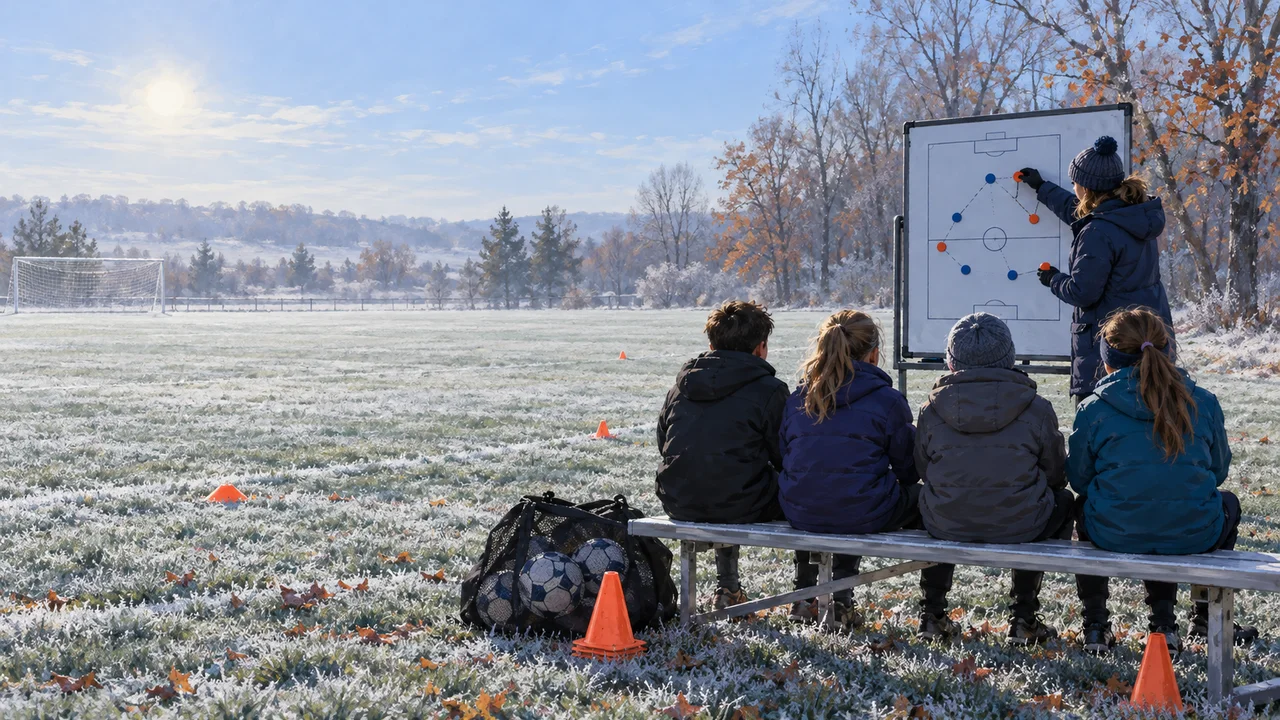
I co-founded Train Daily, and I coach an 11U team in Fort Wayne, IN that plays 9v9. I have coached or assisted every format from 5v5 to 11v11, and this fall my team played 11v11 on a field only 10 to 20% bigger than our 9v9 field. We won one of those games 9-1 against Lakewood Park, a team that had beaten us 3-1 the year before.
What changes when you move from 9v9 to 11v11?
Age drives more of the change than the format number does. Younger players get more fundamentals and more game-based practice, and older players get more positional specialization. The biggest change as players get older is learning to exploit space, and a bigger format adds space to exploit.
At 11v11 the shape itself grows by two players. A 3-3-2 picks up a fourth defender and a fourth midfielder and becomes a 4-4-2. I run a lot of 3v3 and 4v4 inside my 9v9 sessions, so my players meet the decisions of a bigger game in small pieces long before the field gets larger.
How do you explain a 4-4-2 to 11-year-olds?
Describe it as the shape they already play with two additions. I told my players our 4-4-2 was a 3-3-2 plus one back and one mid. They already knew the 3-3-2, so the only new information was two extra jobs.
Eleven players on a field only 10 to 20% bigger than a 9v9 field crowds the middle and rewards quick passing over dribbling, and the 4-4-2 held up well in that space. We gave up two shots on goal all game and won 9-1. I kept the description to one sentence so players had one thing to remember.
I describe formations to players as changes to a shape they know. A label like 4-4-2 names a whole new picture, and a sentence like "3-3-2 plus one back and one mid" names two changes to a picture they already have.
What should stay the same from 9v9?
Keep the principles, the cues, and the roles that already work. Three of mine carry straight over to a bigger game.
- The two phases. When we have the ball, everyone keeps it and scores. When they have it, everyone wins it back.
- Three pressing triggers only, a poor first touch, a backward pass, and slow ball movement.
- The attacking order. Forward first, then sideways, then keep it, with backward last.
The roles carry over too. My center back plays 5 to 8 yards behind the outside backs, and the cue is "CB behind the line." One outside back pushes high in possession while the other stays home. Those rules came out of games, and I'd rather ask players to hold them in a bigger game than hand them new ones.
How do you practice 11v11 without running it every night?
Run the bigger game in small pieces, and save the full-size version for the last block. I keep at least 85% of session time in environments where attack, defense, and transition all show up, and a 3v3 or 4v4 gives each player more touches than 11v11 does while asking for the same decisions.
My exercise bank includes a 5v5 to large goals game on a shortened field, with both teams defending a full goal and a keeper. It teaches realistic finishing and goalkeeper decisions inside a game, and I weight it heavier than other blocks when it closes a session. It can't teach full-field spacing, which is the one thing 11v11 adds, so if a bigger game is coming, spend the last block of one session on the full shape and let players see where the extra back and mid stand.
The small games above come from my exercise bank. The 9v9 practice plan I use walks through that bank, including what each exercise can't teach.
Does fitness matter more at 11v11?
A bigger field means more running, and I build conditioning into the games instead of running fitness sessions. In small-sided games I use one minute on and one minute off, and across the season the rest shrinks while playing time grows. In the 11v11 win over Lakewood Park, the payoff showed up around minute 15 instead of the usual last 10 to 15 minutes, and we spent the final ten minutes possessing and shooting at will. Across the 2026 season through the state tournament in October, we outscored opponents 56 to 6 in second halves.
How should you install the new shape?
Install it in practice and use match day for reminders. Ray Power's idea is that match day is for reminders and not new coaching, because a player walking into a game already carries a lot, and a new formation adds to the load. If you plan to play 11v11 on Saturday, teach the shape on Monday and Tuesday and say one sentence about it before kickoff.
How do you give the new roles a first job?
Give each new role one specific task, then judge the intention instead of the outcome. A winger who reaches the byline and tries the cross has completed the task even when the cross sails over, and now you have something concrete to work on. For the added defender and the added midfielder, pick one job each for the first game, such as "stay behind the ball line" or "connect the back four to the front two."
That approach gives you more ways to win a game you lose on the scoreboard, and it keeps a player who made a bad touch focused on the next job instead of the last mistake.
How do you handle positions and playing time with a bigger roster?
Count your roster first. Eleven players on the field leaves a 14-player roster with three substitutes and a 12-player roster with one, so check your playing-time policy against that number before the first game. Mine is equal playing time over the season and not per game, with a floor of half a game. The equal-minutes rule comes off for tournaments, with a 30-minute floor.
Then keep your position rules when the spots multiply. In my program no player plays more than two positions in a game, and no player moves before spending at least a half in one area. Rotation produced some of my best position reads this season. A forward I moved to a new position shut down the opponent's best attacker, and a fast player who got lost at two other positions settled in at left back. Neither read exists without the rotation.
The middle of our field kept emptying out in one game this season, and that is why my center back now plays 5 to 8 yards behind the outside backs, with a cone line six yards back that she can't cross while the ball is live. When players first learn positions, many swing from running the whole field to never leaving their own quadrant, and about two years later they balance the two. Expect that swing when you add spots.
After you introduce the new shape, check who understood it before the next practice. A reinforcement question in Train Daily takes about two minutes to attach to an assignment, and it can ask which two spots you added to the 3-3-2.
How does the press change with four across the back?
The triggers stay the same, and the back line gets one more player on the rope. I cap pressing triggers at three so players can recognize them, a poor first touch, a backward pass, and slow ball movement, and the cue for the first is "Poor first touch, GO." My defenders are connected by a rope. When one steps, the line steps, and when one drops, the line drops. With four in the back line the same rule covers one more person, so rehearse the step and the drop in a 4v4 or 5v5 before you trust it at full size.
How should you coach the first 11v11 game?
Watch the shape, write down what to fix, and resist coaching live. That is the note in my season plan for first competitive games, and a new format counts as a first game. I treat it as data and not a verdict. During play I ask "what do you see?" or give a short cue of two to five words, 10 to 15 times a half at most, and none of them respond to a mistake. The real conversation happens at halftime, where I fix one thing.
Do older players handle 11v11 differently?
They pay attention longer and take in more detail. I coached my daughter's team a little at 13 and 14, playing 11v11, and those players held attention longer and took in information better than my 11U group. With my 11U team I keep each message short, and the 4-4-2 line was one sentence.
What to do this week
- Describe your 11v11 shape as a change to your 9v9 shape, in one sentence your players can repeat.
- Run the bigger shape inside small games first, and save the full-size scrimmage for the last block of one session.
- Count your roster against 11 on the field, and check your playing-time policy before the first game.
If you want help structuring the sessions around those steps, how I plan a practice around Play-Practice-Play covers the shape I build every session around.