Small-Sided Games vs. Drills: A Guide for Youth Soccer Coaches
Should a youth soccer coach pick small-sided games or drills? Use small-sided games for most of practice, because each rep comes with an opponent, a goal, and a decision. Pull in a drill when a game can't teach the skill, like set pieces or clean passing technique, and keep that block short.
I co-founded Train Daily and coach an 11U team in Fort Wayne, IN, so most of what's below comes from nine-, ten-, and eleven-year-olds. I lean hard toward games. I also pulled one of my own games after two tries, and that flop shows where the "games beat drills" rule runs out.
What is the difference between a small-sided game and a drill?
A small-sided game is a scored game with fewer players on a smaller field, so attack, defense, and transition all show up in the same rep. A drill is a repeated task with a fixed pattern, like passing through cones, where the setup decides what happens next.
The line between them is blurrier than the labels suggest. A game with a rule players can't follow behaves like a bad drill, and a drill with a live defender behaves like a small game. Check three things on any activity. Look for an opponent, look for a direction to score, and look at whether the players or the setup decide what happens next.
U.S. Soccer already builds the youth game this way. According to its game formats page, checked November 2, 2026, the recommended maximum is 4v4 for U7 and U8, 7v7 for U9 and U10, 9v9 for U11 and U12, and 11v11 from U13, and smaller formats can be played at any of those ages. Your Saturday match through U12 is already a scaled-down version of the full game.
When do small-sided games beat drills?
Small-sided games win when the skill is a decision. A game keeps handing players new decisions, and a drill repeats the same one. Nearly everything I want from nine-, ten-, and eleven-year-olds is a decision, like when to scan, when to press, and when to play forward instead of sideways.
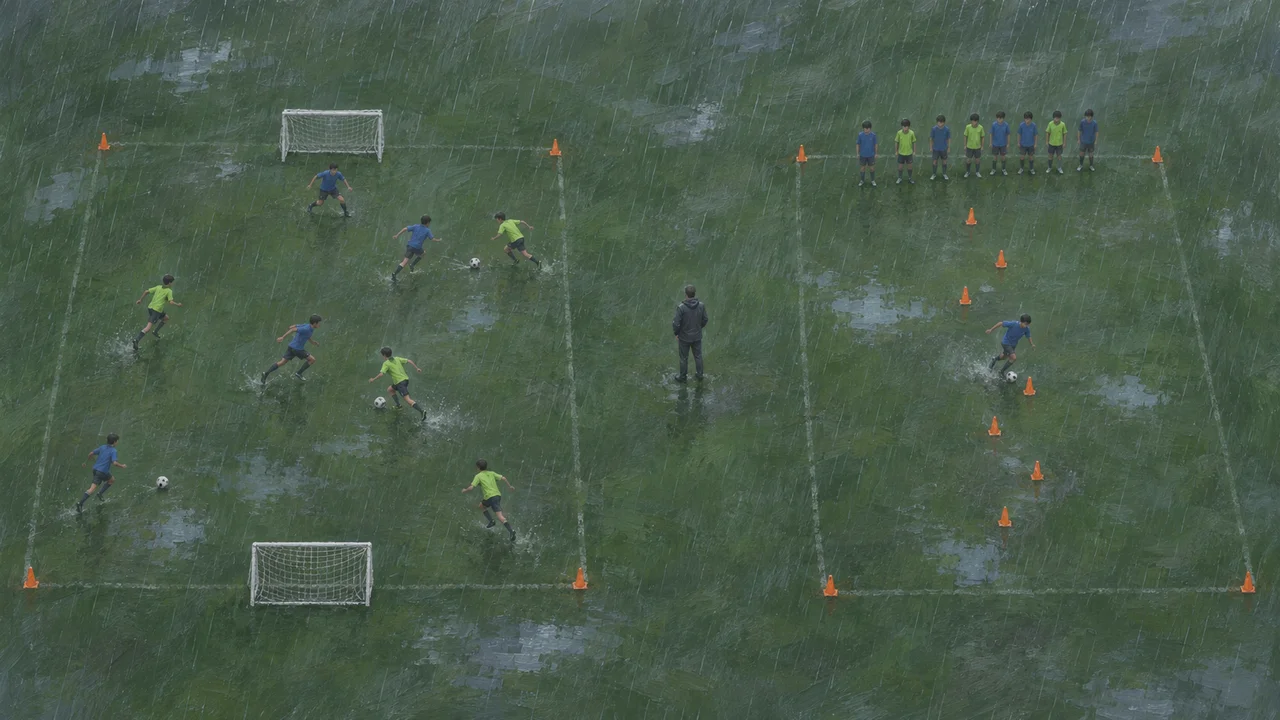
My rule for this comes from Yup Wielandt, a coach at Lech Poznań II. Keep at least 85% of session time in environments where attack, defense, and transition all show up, and coach the day's theme inside one of them instead of drilling attacking or defending alone. I count my club's shared warm-up outside that 85%. Most of my night is games, from a 5v5 to small goals that I watch without talking, to bigger scrimmages that close the session. My two-hour Play-Practice-Play session plan shows how the blocks fit together.
A game also hands you information. When I say almost nothing during the first game of the night, I see what players can already do, and that decides what I emphasize in the block that follows.
My exercise bank lists what each exercise can't teach, and the games on it are no exception. My post on keeping a small exercise bank explains how I write those lists and why I fix an exercise before I replace it.
When does a drill beat a small-sided game?
A drill wins when the skill is a technique that needs the same movement repeated with instant feedback, or when a game can't contain the skill at all.
The best evidence I found is a 2025 study in Frontiers in Sports and Active Living, published April 17, 2025 and checked November 2, 2026. Researchers in Sweden split 17 youth female players, with an average age of 12.7, into two groups for nine 30-minute sessions over 4.5 weeks. One group did passing exercises built around cones and ropes that made a missed pass easy to see, plus a short lecture on technique and coach feedback. The other group played 3v3. The passing group got more accurate on all three accuracy tests. The 3v3 group didn't improve on two of them and got less accurate on the third, a stationary-ball pass at a fixed target.
The authors offered one explanation. In a game, the receiver adjusts to a bad pass, so the passer doesn't feel the miss. Cones and ropes make a miss obvious right away. The study covered one team of 17 players for 4.5 weeks and measured one skill, side-foot passing accuracy, and the passing group got coaching along with the exercises. Treat it as a strong hint about passing technique, not a ruling on games.
My own bank shows the same pattern from the other direction. A 5v5 to small goals can't teach box defending, crossing, goalkeeper interaction, or set pieces. A 5v5 to large goals on a shortened field can't teach full-field spacing, long-ball defending, or the wide areas. So I run corners live, with a keeper and three defenders marking, because a 5v5 to small goals has no keeper and no box.
The same logic changed my game-day warm-up partway through the season. It used to include a small-sided possession game. I replaced it with two half-field overload rounds. Round one moves players out of their usual spots, and round two mirrors the starting lineup. The backs and the keeper start high and drop back to recover on the attacking team's first play, so the rep starts as a transition. I like the overloads better because they give true game spacing and live keeper reps. They still have opponents and a goal to attack, so they sit closer to a game than a drill, but they aren't a small-sided game.
The bank behind all of this is seven confirmed exercises, and each one lists what it can't teach. The full list of seven exercises in my 9v9 practice plan shows the setup and scoring for each.
How do you know when a small-sided game isn't working?
A small-sided game isn't working when players spend more attention on the rules than on the soccer. That happened to me with a possession game I call 31.
Three teams share the field, and at any moment two of them play together against the third. The team in possession earns a point for each connected one-touch pass. The game aims to drive one-touch passing and constant transition between attacking and defending, and I still like that idea. It flopped with my group because players kept losing track of who had the ball and which two teams were paired up at any given moment.
I ran it twice, about 30 minutes in total, and changed nothing. I had about seven practices left in the season, and I didn't want to spend them on a game that confused the group. By the time we stopped, the team had started to figure it out, so I'm not calling it a bad game. I think it's one to two years too advanced for nine-, ten-, and eleven-year-olds, though I'm not certain.
Chris Ramsey's rule of thumb is that players absorb about 30% of a session the first time through and about 60% the second, so two runs is early. A coach with a full season ahead can afford a third. I didn't have the practices, so I pulled it. My post on building a season-long curriculum covers why I repeat sessions and how I hold priorities for weeks.
Check four things before you keep a new game.
- A player can say in one sentence who is on their team and what earns a point.
- The scoring rewards the behavior you came to teach.
- The game has a forward direction, so players can't score either way for equal value.
- When one side keeps winning, you change the conditions before you coach the losing side harder.
How should the mix change as players get older?
Younger players need more fundamentals inside games, older players need more positional specialization, and the biggest change as players age is learning to use space. I've coached or assisted teams in formats from 5v5 up to 11v11, and age changed my practices more than the format number did.
At 9v9 I still run a lot of 3v3 and 4v4 inside my sessions, so players meet the decisions of the bigger game in small pieces. I wrote about how that carries over in my post on moving a team from 9v9 to 11v11.
What should you do with the part that isn't a game?
Put ball mastery there, and move as much of it as you can to off-days. At least 85% in games leaves up to 15% for everything else, and mine goes to ball mastery.
The case for it is simple. When a first touch becomes automatic, the brain is free to make decisions, and decisions are the point of the games. I open each session with 5 to 10 minutes of ball mastery folded into the shared warm-up, and I assign 15 to 30 minutes on days we don't practice. Those assignments are specific and countable, like "50 inside-foot passes with your left against the wall in 10 minutes." Here is how I set up countable off-day assignments.
Off-day ball mastery is the one piece of this a coach can't watch, and that's the gap Train Daily fills. You assign a drill from the video library in about two minutes a day, and it's free for you and your whole roster.
What to do this week
- Count how much of your last practice was a game with an opponent and a goal, leaving out your warm-up.
- Pick one skill a game can't teach, such as corners or passing technique, and give it one short block with a way to see the misses.
- Run any new game twice before you judge it, and make sure players can say who they play with and what earns a point.
Frequently asked questions
What is a small-sided game in youth soccer?
A small-sided game is a scored game with fewer players than the full format on a smaller field, such as 3v3, 4v4, or 5v5 in practice. It keeps attack, defense, and transition in the same possession. U.S. Soccer also scales matches this way, with recommended maximums of 4v4 at U7 and U8, 7v7 at U9 and U10, and 9v9 at U11 and U12.
How much of practice should be small-sided games?
I follow Yup Wielandt's rule of at least 85% of session time in environments where attack, defense, and transition all show up, and I count my shared warm-up outside it. That's one coach's target, not a standard. Bigger scrimmages count toward the 85% along with 3v3 and 4v4, and the remainder goes to ball mastery.
Are drills bad for youth soccer players?
No. A drill earns its time when the skill is a technique that needs repeated reps with feedback, or when a game can't contain the skill. A 2025 study of 17 youth female players found a passing-skill group improved its side-foot accuracy while a 3v3 group did not. Keep drills short, tie them to a game, and write down what each one can't teach.
What age should players start small-sided games?
From the start. U.S. Soccer's game formats page recommends a maximum of 4v4 at U7 and U8 and says smaller formats can be played at any age, so 2v2 and 3v3 are open to the youngest groups. Older players keep using them. I run 3v3 and 4v4 inside 9v9 sessions with nine-, ten-, and eleven-year-olds.
What do you do when one team keeps winning a small-sided game?
Change the conditions before you coach harder. If defenders keep winning the ball, the attackers usually lack the tools in that setup, so give them unlimited touches or help with body position. If attackers score three quick goals, feed more balls so defenders get reps, or demand more from the defenders.
How many times should you run a new game before you drop it?
Run it at least twice. Chris Ramsey's rule of thumb is that players absorb about 30% of a session the first time and about 60% the second, so a first run tells you little. I ran a three-team possession game twice, about 30 minutes in total, and pulled it with about seven practices left because I didn't want to spend more of them on it.