How to Get Your Kid to Practice Soccer at Home Without Nagging
Wondering how to get my child to practice soccer without a nightly standoff? Hand your kid a task with a number on it, run the same one for two weeks, and retire from the nagging business. A kid can win "50 passes against the wall." A kid can't win "go practice."

I coach an 11U soccer team, and I'm a dad. I never played the game myself. I can't demo a Cruyff turn, but I can count to 50, which is most of this job.
Same pattern in both places: kids get better on the days we train, and the ball sits there on the days we don't. Telling my own kids to go practice never worked, so I changed what I ask for.
Why does "go practice" turn into a fight?
"Go practice" is the soccer version of "clean your room." It has no starting point, no finish line, and no way to tell if it's done right. Your kid can't win that, so your kid negotiates. You get tired of negotiating, and the ball goes back in the garage.
An open-ended request also hands your kid three decisions: what to work on, how long to do it, and when it counts as done. Make those calls before your kid sits down and most of the argument disappears.
What does a good soccer practice assignment look like?
It has a skill, a count, and a time limit. Mine sounds like this: "50 inside-foot passes with your left against the wall in 10 minutes."
Compare that to "work on your weak foot." One tells your kid what to do, how many, and when to stop. The other asks your kid to write a training plan, which is a lot to ask before dinner.
You can write these for any skill. Three that follow the same pattern:
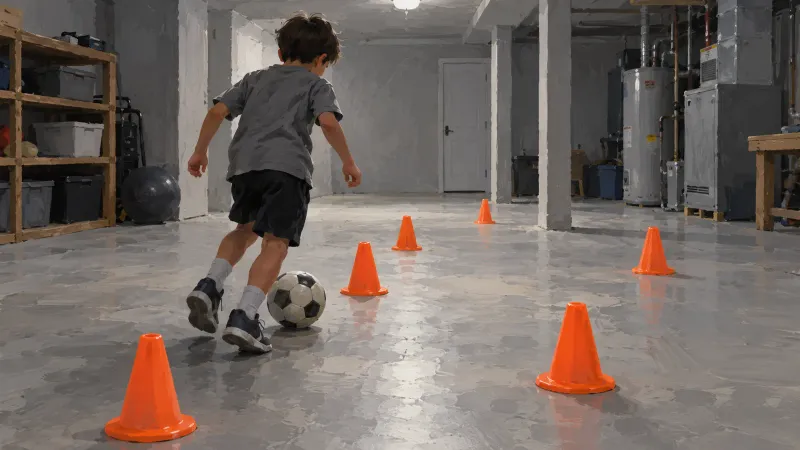
- Dribble between two cones five yards apart for five minutes using only the outside of the right foot, then five minutes with the left.
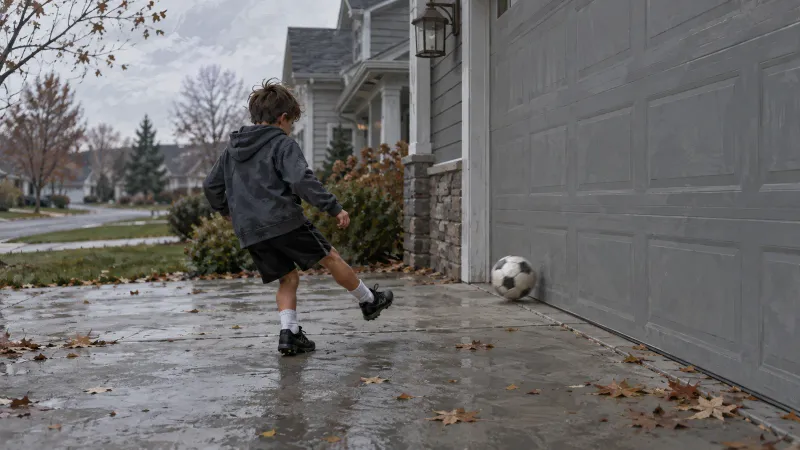
- Pass against a wall with the inside of the right foot until you hit 40 clean ones, then repeat with the left.
- Dribble around the yard while a parent holds up fingers, and call out the number before your next touch.
The third one needs a parent with ten fingers and zero soccer knowledge. It also trains scanning, which is the habit of looking up before the ball arrives. I work that into most of what I ask my players to do.
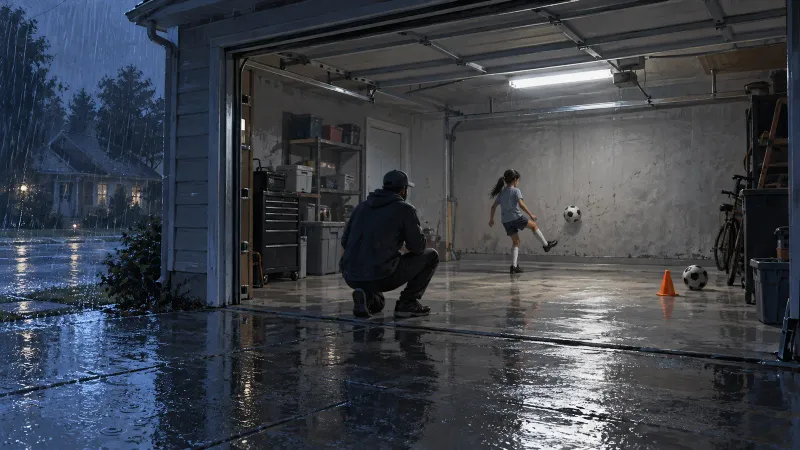
All three need a ball and a wall or a patch of open ground. I write my assignments so a kid can finish them alone. I've used this style with kids ages 9 to 11 and haven't tried it on younger kids, so shrink the counts if yours is smaller.
Why give your kid the same assignment for the first two weeks?
The first two weeks are about the habit, and habits like repetition. On my team, every player gets identical assignments for the first two weeks, and I personalize after that.
I learned this at practice first. I used to change the session every week, and I did it for me, not for the kids. Chris Ramsey, a coach whose interviews I studied, says kids absorb about 30% of a session the first time they run it, 60% the second time, and more the third. So now I repeat the core exercises with small tweaks, and the introduction gets shorter each time.
At home, that means picking one assignment and running it for 14 days. Raise the count when it gets easy. Resist the urge to find something exciting on day four.
How to get my child to practice soccer on days with no team practice
Pin the assignment to the same spot in the day and keep it between 15 and 30 minutes. That's the range my team plan uses on days without a team practice. The post on how much a kid should practice soccer outside of team practice digs into the number.
Tell your kid the count the day before, set a timer, and stop when the count is done, even if your kid wants to keep going. That keeps the finish line believable.
In week one, my Friday message to parents ended with three sentences about what the kids could do on Sunday. It pointed to one place, the Train Daily app, and the work was waiting there.
How do you make soccer practice feel like a game?
Give it a score, a streak, or an opponent. A Bodo/Glimt coach once put a case of Coke in the middle of the field and let the winning team take it home. The drill didn't change. The stakes did.
The intensity came from something being on the line. You don't need soda.
At home, the stakes can be "beat yesterday's count" or "beat your brother's." My own kids get their touches in every day and compete to keep their streaks alive in Train Daily, so I know the sibling version works in my house. A parent wrote this on traindaily.com:
"We are loving the app. My daughter has practiced everyday since starting it. She has never practiced soccer this consistently." Deanna Thompson
Kids also respond to a clock. Train Daily kids see a "5 hours left" notification and scramble to finish their reps before the day resets. You can copy that without the app by announcing when the day's session closes.
If you'd rather not build the streak and the scoreboard yourself, Train Daily for parents puts the day's reps in your kid's Today tab, matched to age and focus, and drops your kid into a group of 20 to compete with. I built it because telling my own kids to go practice never worked.
What should you say when your kid finishes?
Name one thing your kid did well, and skip the technique review if you don't know soccer. I show kids what they did well, especially at 9 to 11, because there's little value in telling a nine-year-old what he's bad at. Knowing what you're good at keeps a kid in the game.
I ask parents for the same thing on the sideline: cheer, don't coach. "Let's go!" is perfect, and "KICK IT!" undoes a month of work. I'd probably yell it too if I were standing there as a dad instead of a coach, so I get the urge. At home, the same rule keeps you in the cheering seat while your kid does the work.
You can also ask for the number. "What was your count today?" gives your kid a chance to report a win, and you don't have to judge a single touch.
What if your kid says it's too hard or too boring?
Adjust the count before you drop the assignment. Too easy bores a kid, and too hard breaks a kid. I aim for high challenge with high support: the count takes effort, and a parent stays close to cheer and help adjust.
When a pass misses the wall or a touch gets away, leave it alone. A kid who tries something and fails is doing more developmental work than a kid who plays it safe to avoid correction. Say "next play" and move on.
If it's too hard, cut the count in half and keep the time. If it's too easy, add 10 to the count and keep the time. Small changes keep the finish line believable.
What if your kid still skips a day?
Plan for it. I plan for 75% of my players to do 75% of the assigned work, so a missed day isn't a crisis. On a week with four non-practice days, 75% is three of the four.
When your kid misses a day, restart the next day at the normal count. Do NOT stack the missed session on top of tomorrow's. If your kid skips several days in a row, shrink the assignment to something that takes ten minutes and rebuild from there.
The number that fits your kid's age is the next question. How much should a kid practice soccer outside of team practice? gives the 15 to 30 minute range from my 9-to-11 team and explains how I plan around missed days.
What to do this week
- Write one assignment with a skill, a count, and a time limit, and tell your kid the count tonight.
- Run the same assignment for 14 days, raising the count only when it gets easy.
- When it's done, name one thing your kid did well and ask for the number.
Frequently asked questions
How long should a kid practice soccer at home each day?
On days without a team practice, my 9-to-11 team plan calls for 15 to 30 minutes of ball work. Pick 15 on a busy day and 30 when there's time. Younger kids may need less, and I haven't tested those ages.
What if I don't know anything about soccer?
You can still run a countable assignment. Ask for the number, hold up fingers for your kid to call out, and cheer the finish. The Train Daily drill library pairs each drill with a video, so your kid can watch the movement before trying it.
Do I need to buy equipment for soccer practice at home?
You need a ball and either a wall or a patch of open ground. My assignments work solo or against a wall. Cones help for dribbling drills, and two shoes or water bottles work as cones. A phone helps if you use an app, but the plain version needs only the ball and the wall.
Should every kid get the same practice assignment?
For the first two weeks, yes. On my team, every player gets identical work so the habit forms before anything personalizes. After that, I tailor the work to each player's development plan. The shared start also keeps things simple: your kid can see what the assignment is and whether it's done.
How do I stop nagging my kid about soccer practice?
Put the skill, the count, and the time in one sentence, say it once the day before, and leave it. Then ask for the number at the end. A clear task replaces the repeated reminders, and the count and the timer do the reminding instead of you.