How Much Should a Kid Practice Soccer Outside of Team Practice?
How much should my child practice soccer outside of team practice? For ages 9 to 11, 15 to 30 minutes of ball work on days without a team practice is a workable range. It's the range I use with my 11U team, and a short session your kid finishes beats a long one your kid skips.
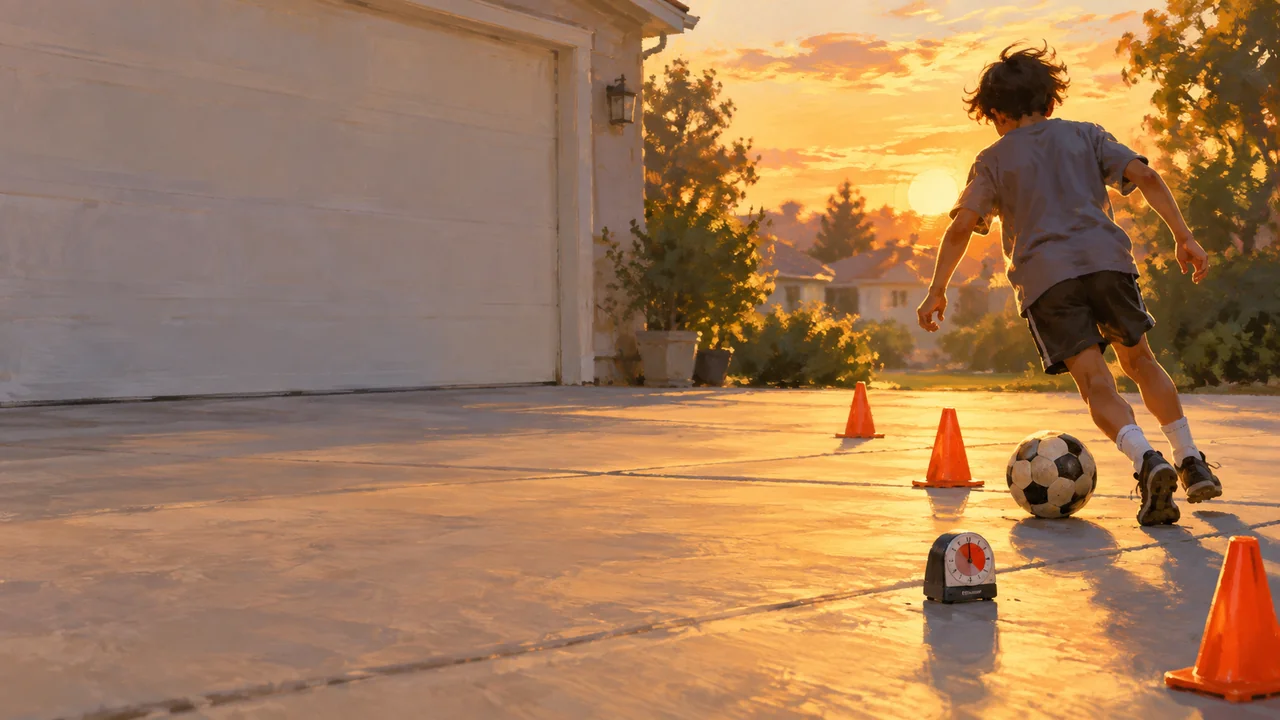
I coach 9-to-11-year-olds in a homeschool club, and we practice three times a week. That leaves four days with no practice, and my plan fills them with 15 to 30 minutes of ball mastery. The number comes from that team, so I'll say whose it is each time I use it.
How much should my child practice soccer on a day with no team practice?
Aim for 15 to 30 minutes, and treat 15 as the version for a busy day. That's the plan I run with my 9-to-11 team, written for days when the team doesn't meet. The work is ball mastery only: touches, passes, and dribbling, with no sprints and no fitness drills.
I keep it to ball mastery because the goal is automatic comfort with both feet. When a first touch is automatic, the brain is free to make decisions. That is the entire argument for off-day work.
Even five to ten minutes on a busy day keeps the habit going. A 10-minute session on a hard day beats a skipped day.
How many days a week should a kid practice soccer at home?
Practice on the days your team doesn't. Team practice days already count, so the home plan fills the gaps. With three team practices a week, that means up to four home sessions.
I plan for 75% of my players to do 75% of the assigned work. On four non-practice days, 75% is three days. Three of four is the version I plan for, and a fourth session is a bonus.
A missed day is part of the plan. Restart the next day at the normal length instead of doubling up.
Here is what that looks like across a week on my team. We practice Monday, Tuesday, and Thursday, and games land on Saturdays or on a weeknight.
| Day | What happens |
|---|---|
| Monday | Team practice |
| Tuesday | Team practice |
| Wednesday | Home session, 15 to 30 minutes |
| Thursday | Team practice |
| Friday | Home session, 15 to 30 minutes |
| Saturday | Game, or a home session if there's no game |
| Sunday | Home session, 15 to 30 minutes |
Why do the days between practices matter?
Those days have no one building the session, so the assignment has to carry the structure. My best practice night so far, on September 3, 2026, produced over a thousand touches per player in two hours. That happened because I built the session around a running score, locked teams, and a weighted final game. A home session has no coach and no scoreboard, which is why I give kids a count and a time limit.
Three practices a week leave four days with no practice at all. If a kid does nothing on those days, the ball sits still for most of the week. A 15-to-30-minute session fills the gap without taking over the evening.
What should the 15 to 30 minutes include?
Simple touches on both feet, with a count. The assignment that works best for my players reads like this: "50 inside-foot passes with your left against the wall in 10 minutes." It names the skill, the number, and the time.
The material I studied on ball mastery points the same direction. Anson Dorrance's program at UNC and Coerver coaching built ball mastery around six core moves, inside and outside of each foot, repeated until they became automatic. The aim was repetition, not complexity. Mia Hamm said Kristine Lilly "mastered the ordinary, and that made her extraordinary."
Here is one way to build a 20-minute session from that pattern: 8 minutes of wall passes with the left foot, 8 minutes with the right, and 4 minutes of dribbling while a parent holds up fingers for your kid to call out. The fingers train scanning, which means looking up before the ball arrives. You don't need soccer knowledge to hold up fingers.
Make the session a contest. If you line a kid up and say "do pull-pushes for 5 minutes," you've lost the kid. Race the timer, beat yesterday's count, or set a family challenge. Competition keeps the touches coming without a lecture.
If you'd rather not plan the weekly sessions, Train Daily for parents hands your kid the day's reps in the app, matched to age and focus, with a video for each drill. I built it so a parent doesn't have to write the plan.
Is more practice better than 30 minutes?
My plan stops at 30 minutes. I measure a season by whether every kid leaves the last game wanting more, and a home session can pass the same test. End a session while your kid still wants another round.
For questions about workload, growth-related injuries, or a child who complains of pain, ask your child's pediatrician. This post covers a coaching plan, not medical advice.
How do you know the length is right for your kid?
Watch what happens around minute 15. A kid who is still trying new touches and finishing counts has the right length. A kid who is staring at the timer or tossing the ball has hit the ceiling for that day.
I use a rule from game days for this. A kid getting beaten one-on-one is having the best training session of his life for about 60 minutes, and after that it stops teaching and starts eating confidence. The breaking point differs by kid, and reading it is part of the job. At home, the same idea applies to a count your kid can't hit: stretch the count, and stop before it breaks the kid.
If your kid hits the count easily for several days, add to it. If your kid misses it for several days, cut it. Keep the time limit steady and change the count.
Who should set the number, you or the coach?
Ask the coach first, then set the number yourself if the coach hasn't. Coaches who assign off-day work will give you a count and a time. Coaches who don't assign it leave the decision to you, and the 15-to-30-minute range gives you a place to start. If your coach and this post disagree, follow your coach, who knows your kid and your team.
Tell your coach what you're doing at home. A coach who knows your kid practices 15 to 30 minutes on non-practice days can build on it, and a coach who sees the same touches in the next practice can adjust.
What if my child wants to do more than 30 minutes?
Let the extra time be play. My plan caps the assigned session at 30 minutes, and a kid who wants to keep kicking around the yard afterward can do that without a count. The assigned work stays short and finishable, and the free play stays free.
Does the number change for younger or older kids?
It may. My number comes from a 9-to-11 team, and I haven't run the plan with other ages, so I won't give you a figure for them. Ask your child's coach what they expect, then pick a length your kid will finish happily.
Getting your kid to start is a separate problem from choosing the length. How to get your kid to practice soccer at home without nagging covers how I write assignments with a count and a finish line.
What to do this week
- Count the days your child has no team practice, and plan a session of 15 to 30 minutes for each one.
- Expect to hit three of four days, and restart the next day after a miss.
- Write each session with a skill, a count, and a time, and end it while your kid still wants more.
Frequently asked questions
How long should a 10-year-old practice soccer at home?
For ages 9 to 11, my team plan uses 15 to 30 minutes of ball mastery on days without a team practice. Pick 15 minutes on a busy day and 30 when there's time. That number comes from my 9-to-11 team.
Is 10 minutes of soccer practice enough?
Ten minutes keeps the habit going on a hard day, and my notes say even five to ten minutes of daily ball work makes a difference. My target is still 15 to 30 minutes on most non-practice days. Use 10 minutes as the floor, not the plan.
Should my child do fitness work on days without team practice?
My off-day plan is ball mastery only. My players get conditioning from small-sided games, and I run no sprints or fitness sessions. For a conditioning plan tailored to your child, talk with your child's pediatrician or a certified athletic trainer.
How many days a week should my child practice soccer?
On the days the team doesn't practice. With three team practices a week, that's up to four home sessions. I plan for 75% of players to complete 75% of the work, which works out to about three of four days.
What if my child has no team practice at all?
My plan assumes a team that practices three times a week, and I haven't tested it without one. You can use the same 15 to 30 minute session length and choose the days that fit your family. Start with fewer days and add as the habit forms.