Soccer Skills for a 9-Year-Old: What They Should Do and Practice at Home
The soccer skills a 9-year-old should be working on come down to three things: both feet, honest scanning, and good decisions in small spaces, not a long checklist of fancy moves. Below is what to drill at home, what changes once the field opens up to 9v9, and how to handle the tears that come with trying hard things at this age.

I coach a roster of 9-to-11-year-olds, and the 9-year-olds on it are already playing in a bracket built for 9v9. Most 9-year-olds aren't there yet. That gap is useful, because it tells you exactly what's coming and what's worth building now so the jump doesn't knock your kid over later.
What soccer skills should a 9-year-old be working on?
Three things matter more than any drill list: comfort with both feet, scanning before the ball arrives, and making a decision in tight space instead of freezing or panicking. Everything else, from a good first touch to a clean pass, sits on top of those three.
Both feet means your kid can receive, pass, and dribble with the weak foot without it turning into a disaster. Scanning means checking what's around before the ball gets there, not after. I teach a cue for this from day one: picture, then ball, meaning take the picture of the field before you take the ball. Decision-making is the part most home practice skips entirely, because it's the hardest to drill alone, but it's also the part that separates a 9-year-old who plays fast from one who looks stuck.
Shooting and dribbling moves matter too, but they're not where a 9-year-old is behind. Scanning and weak-foot comfort are the two gaps I see most on a roster this age, and they're both things a kid can build at home without a coach standing over them.
U.S. Soccer's own guidance for this age group points at the same three things: better technique with both feet, passing and shooting out to about 20 yards, and real reps at more than one position, which I checked on October 6, 2026. None of that needs a travel team or a private trainer. It needs a ball, a wall, and the same ten minutes most evenings instead of an hour once a week.
What format do 9-year-olds play, and what's different about it?
Most 9-year-olds play 7v7. That same U.S. Soccer guidance calls for small-sided games from 1v1 up to 7v7 for the U9-U10 bracket. A 9v9 game, which is the format for U11-U12, is usually still a year or two away.
The jump from 7v7 to 9v9 isn't just two more players on each side. The field gets wider and longer, there are two center backs instead of one, and the space a midfielder has to cover roughly doubles. A kid who got by on pace and a good first touch in 7v7 suddenly has to read a bigger picture before the ball arrives, because the extra width means the easy out-ball isn't always there anymore.
Because a handful of my own 9-year-olds are already in that 9v9 environment, I've watched the adjustment up close. The ones who struggle aren't the ones with worse feet. They're the ones who never built the scanning habit, so the bigger field just means more space they aren't checking. The ones who adjust fastest already had picture, then ball as a habit, not a new instruction. If your 9-year-old is a year or two from that jump, scanning is the skill to build now, before the field gets bigger and the habit gets harder to install under pressure.
The size range at this age makes it messier too. A coed roster of 9-to-11-year-olds can run from a kid who looks 8 to a kid who looks 13, and I don't have a clean, finished progression for teaching contact tolerance across that gap yet. What I do instead is pair players by size and confidence first, never by anything else, and let a kid earn harder matchups as comfort builds. It's not a tidy system. It's the one that keeps a smaller 9-year-old from getting bullied out of the game before the skills get a chance to show up.
Ball mastery drills a 9-year-old can do at home
Keep it to touches on both feet, with a number and a time limit attached. A kid can win "40 inside-foot passes with your left foot against the wall in 8 minutes." No kid can win "go work on your weak foot," because that request has no finish line.
- Wall passes, inside of the foot, 8 minutes per foot, counting clean passes against a number.
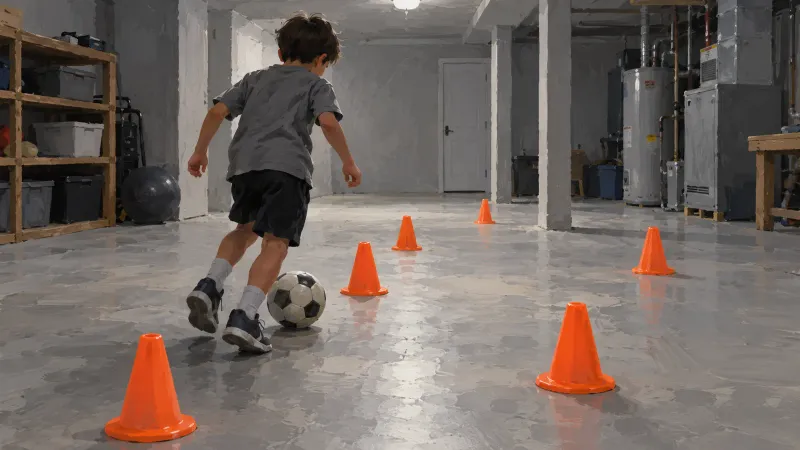
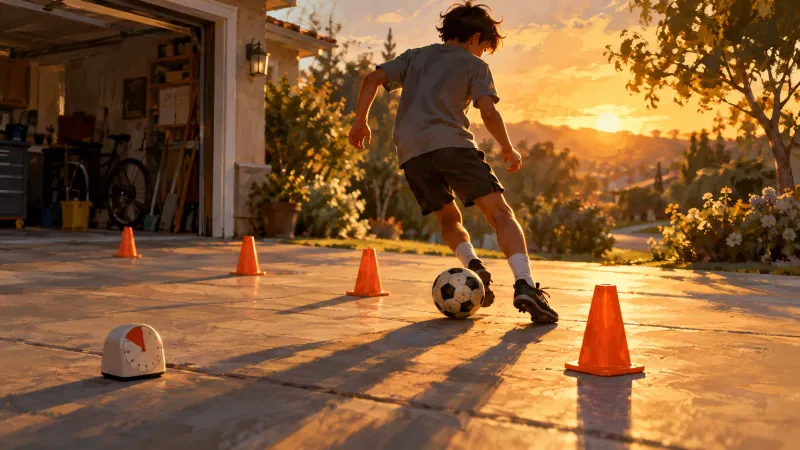
- Dribble through two cones five yards apart, right foot only for one stretch, left foot only for the next, timed instead of counted.
- Dribble around the yard while a parent holds up fingers for your kid to call out before the next touch. This one trains scanning directly, and it needs zero soccer knowledge from the parent holding up fingers.
- Juggling or toe-taps for a set number instead of a set time, since a count gives a kid something concrete to beat the next day.
Want the exact format so your 9-year-old can run an assignment without you hovering over it? How to get your kid to practice soccer at home without nagging breaks down how to write the count and the time limit so a kid can finish it alone.
Twenty minutes covers the first three if you split it 8, 8, and 4. Run the same assignment for two weeks before changing anything. Kids absorb a session gradually, not all at once, and changing the drill every few days just resets the learning curve before it pays off.
On a short night, cut the time and keep the skill. Eight minutes of wall passes beats a skipped day, and a kid who finishes a short assignment easily is a better sign than a kid who drags out a long one. The goal is a habit that survives a busy week, not a perfect session that only happens when the schedule cooperates.
If writing a new assignment every few days feels like a part-time job, that's the exact gap Train Daily was built to close. It hands your kid the day's reps with a video for each one, matched to age, so a 9-year-old opens an app instead of waiting for you to write the plan.
What to do when a 9-year-old melts down after a mistake
Give space first, not a lesson. The part of the brain that handles emotional regulation, the prefrontal cortex, is nowhere near finished building at nine. A kid who comes off the field in tears after a missed shot isn't being dramatic. His brain hasn't built the part that would let him shake it off on command, and no amount of telling him to calm down installs that faster.
I run a two-minute rule for this. When a player comes off upset, I give space, hand over water, sit nearby, and wait. Approaching at the ten-second mark feels like coaching to me and like noise to a nine-year-old. Giving it two minutes usually means the kid comes to me instead of the other way around, and whatever I say next actually lands.
When you do talk about the mistake, praise the decision separately from the execution. A kid who sees the pass, plays it, and overhits it made the right read and missed the finish. Jump straight to the finish and your kid learns to stop trying the pass at all. Name the decision first and the finish keeps getting chances to improve.
Give your kid words for what he's feeling too. Most 9-year-olds don't have the vocabulary yet, and a feeling without a name is a lot harder to move through than one you can actually say out loud.
Does position matter yet for a 9-year-old?
Not in any permanent sense. The reads a player needs, when to press, when to drop, when to make the run, show up at every position, and a kid who only ever plays one spot never sees the game from the other side of it. On my own roster nobody moves before finishing at least a half in a position, but nobody gets locked into one either until closer to eleven or twelve.
Rotating positions has produced some of the best reads I've seen all season. A player who'd spent the year up front, scoring goals but prone to disappearing from the game, got moved to the back line and shut down the other team's best attacker cold. He'd never have found that read staying at forward. If your 9-year-old's coach moves kids around, that's not a demotion. It's where the next skill usually comes from.
Let your kid try multiple spots in rec or club ball if the coach allows it, and don't panic if their best position this year isn't obvious yet. Nine is early to specialize, and a player who's seen the game from three different spots on the field reads it better from all three later.
What a 9-year-old's development plan should include
Show your kid what he did well before you show him what needs work. There's little value in telling a nine-year-old everything he's bad at. What keeps a kid in the game is knowing what he's good at, so at least one priority on any development plan should build on an existing strength instead of patching a weakness.
I build every player's plan around three priorities, one technical, one tactical, one mental, and before I decide any of them, I ask the kid what he wants to improve first. A player who asked for the help learns faster than one who was just told what to fix. At nine, some answers come back thin, which is fine. The point is starting from something the kid already cares about.
The question most parents of a 9-year-old actually want answered is how much of this to run, and how often. How much should a kid practice soccer outside of team practice? covers the 15-to-30-minute range I use and how I plan around a missed day, so I won't repeat the math here.
A plain fact before you build a plan around any of this: the brain-development points above apply broadly across the 9-to-11 range I coach, but I haven't run this specific list of drills with younger kids, so shrink the counts if your kid is smaller or newer to the game.
What to do this week
- Pick one ball mastery assignment with a skill, a count, and a time limit, and run it for two weeks before changing it.
- Add a scanning habit, the finger-count dribble or picture, then ball out loud during games, since it matters more at nine than most parents realize.
- The next time your kid melts down after a mistake, give two minutes of quiet before you say anything at all.
Want the age-specific reps built for you instead of writing them yourself? Train Daily for parents matches the day's work to your kid's age automatically, so the 20-minute plan above shows up in the app instead of on a sticky note.