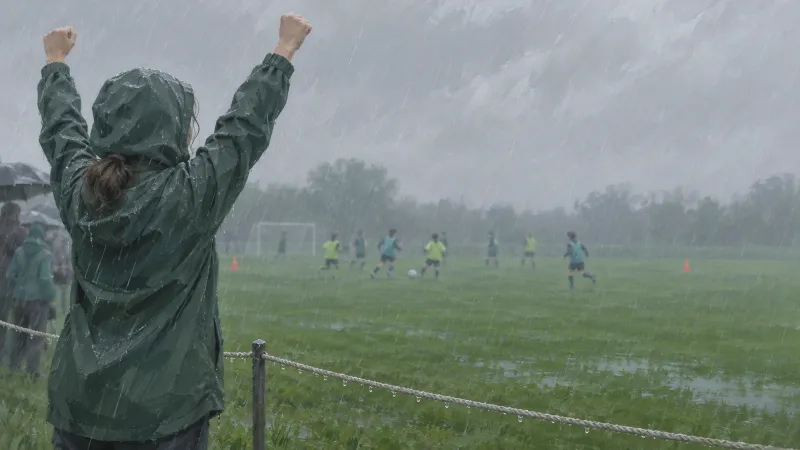
How to Build Confidence in a Young Soccer Player
How do you build confidence in a young soccer player? You lower what a mistake costs, praise the specific things your kid already does well, and hand your kid reps they can finish. Confidence comes from evidence, so a small win does more than a pep talk.

I co-founded Train Daily and coach in Fort Wayne, IN. This fall one of my defenders lost his confidence over a few games. I rebuilt it with a position change and a 16-0 game, after a substitution that didn't go to plan. The same ideas work for your kid, whether the next game is a state tournament or a Saturday morning rec match.
Why does a young soccer player lose confidence?
A young player loses confidence when the same mistake keeps costing something. Getting beaten on a dribble in practice costs nothing. Getting beaten in a game, watching the other team score, and hearing a groan from the sideline costs a lot, and the player draws a conclusion about themselves. That conclusion is usually "I'm bad at this." A speech can't talk a player out of it. New evidence can.
Watch for the signs. A confident player calls for the ball. A player who's lost confidence stops asking for it, passes backward at the first sign of pressure, drifts away from the play, or goes quiet after a mistake. Those habits protect the player from another mistake, which is why they stick around.
What does a confidence slump look like in a real game?
My team plays a 3-3-2 in 9v9, which means three backs. A back is the last field player between the ball and our goalkeeper, so a back who gets beaten hands the other team a shot. One of my backs was my fourth choice at the position. He's smaller than most players he faces, athletic, and unsure of himself on the ball. Against bigger, faster opponents he got beaten, and he knew it.
My plan for him during the season was simple. About ten minutes into a game, he'd come on for roughly five minutes at left back, then slide over to right back, while my three starting backs each took a short break in the first half. We aim for equal playing time over three or four games, not in each game, and late in a close game I play to win.
His last game or two of the regular season went badly against bigger, more athletic teams. By the state tournament he had played about ten minutes in the entire first half of our first game.
What happened when I put him in against their best winger?
We led that game 2-0 in the second half, and it was one of the most competitive games of our season. I'd been trying to figure out when to play him, because I knew their best winger would beat him. Then their coach pulled that winger off the field. I saw my window and swapped my struggling back in at right back for my starter, who is also my best defender and could use a few minutes of rest, since we had another game that afternoon.
About a minute after I made the change, their best winger came back on and lined up one-on-one against him. I turned to my assistant coach, Patrick Sordelet, and said, "Oh crap, they just subbed him back in. This is not going to go well." I put my starting right back straight back in, after about 90 seconds on the bench. About ten seconds later, they scored. It was the only goal we gave up all weekend, and we won that game 3-1.
I read their substitution, acted on mine, and reversed course in under two minutes. Calls like that don't always work out, and this one didn't.
What fixed his confidence?
Where I played him did. I started using him as a sub at midfield instead of at the back. A midfielder who gets beaten has the back line behind him to clean up the play. A back who gets beaten is the last player before the goalkeeper. He had the same size and the same skills in both spots, and a mistake cost far less at midfield.
He started to thrive there. He got his confidence back over the rest of that game, played some midfield minutes in our second game that afternoon, a 2-0 win over our biggest rival, and by the final I felt confident he'd play well. He did.
The third game gave him the most minutes. We knew well in advance we'd beat that team by a lot, and the final score was 16-0. To keep the margin down, we played the entire second half with seven players on the field. I let him play all but about two minutes of each half, and those minutes helped him build his confidence further.
Look at what changed for him. His role got cheaper to mess up. He got a full game where nothing he did could hurt the team. And he had a position where doing the job well was a realistic goal. You can build all three for your own kid.
How do you lower what a mistake costs for your own kid?
Ask the coach a question instead of making a request. "Where on the field does my kid get to play freely?" gives the coach room to answer with a role. A coach who rotates players, like I do, has an answer to that, and the coach picks the position.
Ask how minutes get handed out when a game is already decided. A shaky player collects touches in a game that's out of reach at almost no risk, and the same touches in a one-goal game carry a lot of it. I gave my defender nearly all of a 16-0 game for exactly that reason.
At home, set the count where your kid wins most days. If your kid hits the count easily for several days, add to it, and if your kid misses it several days in a row, cut it. I cover how to size a session in my post on how long a home practice should run.
After a mistake in a game, give your kid time before you say anything. On my team, I give a player who comes off upset about two minutes of space, water, and company before I say a word. Approaching at ten seconds feels like coaching to me and sounds like noise to the player.
How do you praise a young soccer player without it sounding fake?
Name the specific thing you saw. A stream of "good job, good job" turns into noise within a few minutes, and a player stops hearing it. When I want parents to notice something, I point them at a great pass, or a run that leads to nothing but is exactly what the team is working on.
Praise the decision separately from the execution. A player who sees the right pass and overhits it made the right read and missed the finish. Say so. If each correction follows a mistake and each mistake gets the same flat reaction, your kid eventually stops trying the harder pass.
Build on strengths too. Ask your kid what they'd like to get better at, and keep one of the answers tied to something they already do well. Each development plan I write for a player includes at least one item that builds on a strength.
Your words carry extra weight, and that grows as your kid gets older. My post on what a 10-year-old should practice at home covers how I handle that with my own son. For an older player, my post on what to do when your 11-year-old wants less of you at practice covers stepping back.
Specific praise works best inside a feedback routine you repeat the same way each time. I use the same four steps with every player on my team, my own son included, and I describe them in my post on coaching your own child.
How can daily practice at home build confidence?
Give your kid reps they can finish. "Work on your weak foot" has no finish line, and "50 inside-foot passes with your left against the wall in 10 minutes" does. A finished rep is a small win, and small wins stack into the evidence a young player needs. I walk through how to write one in my post on getting your kid to practice at home without a fight.
A number that moves works even better. The two-target redirect drill in my post on building a reliable first touch with a wall and two cones counts clean redirects in a 90-second round, and your kid tries to beat the best round from yesterday. If the count stalls for a week, move the cones in.
A streak adds a second kind of proof. One of my own kids will do his reps at night before he'll break his streak, a habit I describe in my post on turning practice into a habit.
A short daily rep your kid finishes is a win nobody else has to see. Train Daily hands your kid the day's reps with a video for each drill, matched to age and focus, and it's free to use with no card required.
When is low confidence more than a confidence problem?
A bad month and a lasting change look different. A player who dreads games, complains of feeling sick before practice, or loses interest in a sport they loved needs more than a better role or a better rep. Talk with your child's pediatrician or a counselor. I'm a coach, not a clinician, and everything above covers coaching and parenting around soccer, not mental health care.
What to do this week
- Watch your kid's next game and notice where a mistake would cost the most and where it would cost nothing. Then ask the coach where your kid plays freely.
- After the next practice, name one specific thing your kid did well before you say anything else.
- Write one home assignment with a skill, a count, and a time limit, and set the count where your kid hits it most days.
Frequently asked questions
How do you build confidence in a shy young soccer player?
Lower the cost of mistakes and raise the number of small wins. Give your kid a home assignment with a count they can hit, name one specific thing you saw them do well after each game, and ask the coach where your kid can play freely. Confidence follows evidence, so build the evidence first.
Should I tell my kid to be more confident?
Telling a young player to be confident gives them nothing to point to. Evidence works better. A short home rep they finish, a specific thing they did well, or a role where mistakes cost little all give your kid proof. Save the encouragement for effort and decisions you can name.
Can a position change help a young player's confidence?
It can. At my state tournament, I moved a struggling back to midfield, where a mistake costs less because a back line stands behind him. He thrived there. A coach decides positions, so ask the coach where your kid plays freely instead of requesting a specific move.
How long does it take to rebuild a young player's confidence?
It depends on the player. My defender went from a rough end to the regular season to playing well in the state final, across one tournament weekend. Expect gradual gains tied to specific wins, and talk with a pediatrician or counselor if the worry sticks around or grows.