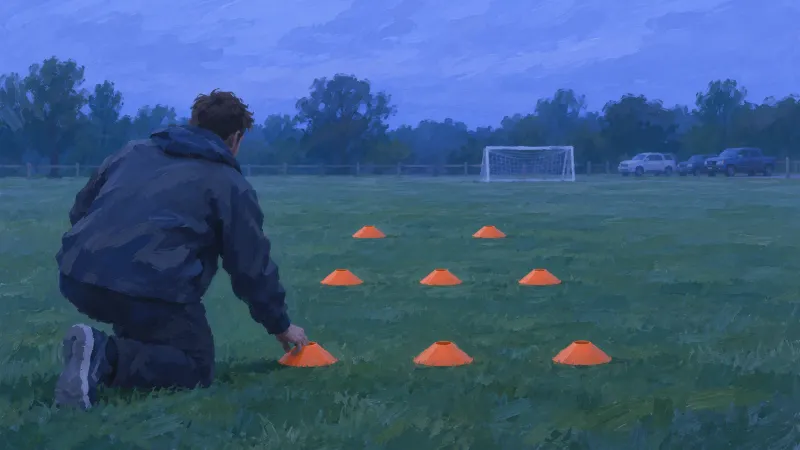
Fun Soccer Practice Ideas for Youth Soccer Coaches
Fun soccer practice ideas work when they're a repeatable format a team expects, not a surprise bolted onto a regular session. Announce them ahead, keep the stakes small, and don't let them replace the night's teaching.

I co-founded Train Daily and coach an 11U team, and the fastest way I've found to kill a flat week of practice without wasting a minute of teaching is a handful of repeatable formats my players already know are coming. Fun soccer practice ideas that work share three things: they're announced in advance so nobody feels ambushed, the stakes stay small enough that losing doesn't sting, and they run inside the same teaching structure as any other night instead of replacing it.
Here are four I run with my own team, roughly once a week, big games included.
Pro Jersey Day
Players show up in their favorite professional kit instead of practice gear. That's the whole idea, and it costs nothing to run. What it buys you is a locker-room energy before the whistle even blows, since players are comparing jerseys and talking trash about which league is better before you've said a word about the session plan.
I run this early in the week, never the night before a game, so it stays a fun reset rather than a distraction from game prep. It's one of the cheapest tools in the bank, because the only cost is announcing it a few days ahead so players remember to bring the right gear.
Celebration Day
Goals only count toward the scrimmage total if every player on the scoring team has touched the ball on that possession. A team that normally funnels every attack through its one or two best players suddenly has to find the quiet player in the corner before the goal counts at all.
This one does real teaching work disguised as a gimmick. It forces possession and spacing habits you'd otherwise have to drill directly, and players police each other on it without you saying a word, because nobody wants to be the reason a goal gets waved off.
Playing a scrimmage with a size one ball
Swap the regulation ball for a size one, the kind meant for toddlers, for one scrimmage. Touch and control get harder in a way that's obvious right away, and players who normally coast on size and strength suddenly have to rely on the same technique everyone else does. It also looks ridiculous, which is most of the appeal.
I run this as a single scrimmage inside a normal session, not the whole practice, so it stays a change of pace instead of the night's entire lesson.
Dropping a yoga ball on the field
Mid-scrimmage, roll a yoga ball onto the field as a second object in play. It doesn't do anything tactical. It's chaos for its own sake, and that's the point. Players laugh, lose track of the real ball for a second, and come back to the game looser than they went in.
This is the one I run least often, since it works best as a surprise inside an otherwise normal week rather than something players expect on a set day.
How often should you run something like this?
About once a week is enough to keep practice feeling varied without it becoming the whole identity of your program. I run one of these four most weeks, and I don't make an exception for a big game either way. I don't add one in to loosen the team up, and I don't pull the regular one to "get serious." A novelty format that shows up every single practice stops being a novelty and starts being the thing players expect instead of the teaching, but a format that disappears the one week it's supposed to show up sends its own message too.
Announce whichever one is coming a few days ahead. The element of surprise isn't the appeal here. Knowing something different is coming Thursday is what gets a tired team through a Tuesday.
None of this replaces the teaching in a session. My post on structuring a single practice around Play-Practice-Play covers the shape I build every session around, with a format like one of these dropped in as a change of pace, not a substitute for it.
What keeps a fun format from becoming a distraction?
A clear line between the format and the teaching. Pro Jersey Day and the yoga ball don't touch the night's lesson at all, so they're pure energy, nothing more. Celebration Day and the size one ball scrimmage double as teaching tools, which is exactly why I run those two more often. The format that teaches something while also being fun earns a bigger share of your practice calendar than the one that's a pure mood boost.
Small stakes change the energy of a session fast, which is the whole philosophy behind this. Winners staying on for the next small-sided round, or the losing team running the next kickoff, work the same way on an ordinary Tuesday with no theme attached at all. My full-season version of that same idea is a running competition I call Competition Night, which gets its own post down the line. You don't need a named event every week. You need a session that has some stake to it, even a tiny one, more weeks than not.
How do these fit with other competition formats you already run?
They stack, rather than compete with each other. I also run a scored 3v3 tournament format to test whether a scanning habit holds up under real pressure, which is a different kind of competitive structure than any of the four here, built around testing a specific skill rather than generating pure energy. The two approaches don't overlap. One checks whether a lesson landed. The other makes Tuesday better, and nothing more.
The same logic applies to healthy trash talk between teammates on a team leaderboard, which runs entirely outside of practice and costs you zero session time. A program with several small, low-stakes competitive threads running at once, some inside practice and some outside it, tends to have more consistently engaged players than one relying on a single big competitive event each season.
Do these ideas work for every age group?
Mostly, with the stakes adjusted. A size one ball scrimmage is funnier and more useful for a team old enough to normally control a regulation ball with ease, since the contrast is what makes it work. For a younger group still learning first touch on a regular ball, the same idea loses its teaching value and becomes a smaller ball, nothing more. Celebration Day and Pro Jersey Day scale down cleanly to almost any age, since neither depends on a skill gap to land.
Watch how your own team reacts the first time you run one of these, and adjust from there. A format that gets a big reaction from one roster can land flat with another, and the only way to find out is to try it once and watch.
Keeping track of what players complete between practices is a separate problem from keeping practice itself fun, and it's the one Train Daily is built to solve. The two work well together: fun formats carry the in-person energy, and the app carries the off-day accountability.
Which one should you try first?
Start with Pro Jersey Day. It costs nothing, needs no setup, and tells you more about your own roster's personality than any of the other three. Watch who shows up in a kit and who forgets, who talks trash and who stays quiet, and you'll learn something about how to run the other three formats with this specific group of players.
Celebration Day is the one I'd pick second, since it does the most teaching work per minute of any format here. If your team already struggles to spread the ball around to quieter players, it's less a fun add-on and more a direct fix for a real problem, wearing a costume.
Building your own rotation
Write down four or five formats beyond these, since your own roster might respond better to something else entirely. Rank them by how much actual teaching they do versus how much they're a pure mood boost, and lean toward the ones that do both. Pick a day of the week to be your default "something's different" day, announce it a few days out every time, and keep running it on schedule even in the week of your biggest game.
The goal isn't variety for its own sake. It's a team that shows up Tuesday expecting the work to be hard and occasionally strange, instead of only hard.
Frequently asked questions
Do fun practice ideas replace real coaching?
No, and they shouldn't be designed to. The four formats here sit inside a normal practice structure, either as a quick scrimmage variation or a standalone mood boost, never as the entire session. If a fun format is eating most of your practice time, it's grown past its job.
How do you introduce a new format without it feeling forced?
Announce it a few days ahead instead of surprising the team at the whistle, explain the one simple rule in a sentence, and run it inside a scrimmage players were already going to play. The ones that feel most natural change one rule of a game players already know, rather than introducing something entirely new.
What age is too young for these formats?
Pro Jersey Day and Celebration Day work at almost any age, since neither depends on players already having strong technique. The size one ball scrimmage works best once a team has outgrown the regulation ball being a real challenge, since the contrast is the whole point.
Should you run a fun format the week of a big game?
Only if it's a normal part of your routine. Don't introduce these the week of a big game to try to loosen your players up, and don't withhold them to try to "get serious" for the big game. Use them no more or less in a big game week than you normally would.
Pick one of these, announce it a few days out, and run it inside a practice that still does its job. The format is the easy part. Knowing when to skip it is what keeps it fun instead of routine.