How Youth Soccer Coaches Can Keep Players Sharp Over a Multi-Week Break
To keep youth soccer players sharp over a multi-week break, send one short ball mastery assignment on most days of the break, give every player the same assignments for the first two weeks, and make completion visible to the team. Schedule rest days on purpose, and if the break runs a month or longer, give part of it back to your players as time off.
I co-founded Train Daily and coach an 11U team in Fort Wayne, IN. Another coach, Armando Sanchez of Blair YSC, reported this on the Train Daily coaches page.
"My boys came back from a two-week break better on the ball than before they left. Never seen that in my 20 years coaching." Armando Sanchez, Blair YSC
Train Daily is my app, so weigh that quote with my bias in mind. It's one coach's report, I can't verify it, and his quote doesn't say what his players did over those two weeks. I can give you the off-day system I run during the season, stretched to cover a break of two weeks, a month, or longer.
What should players work on during a break from team practice?
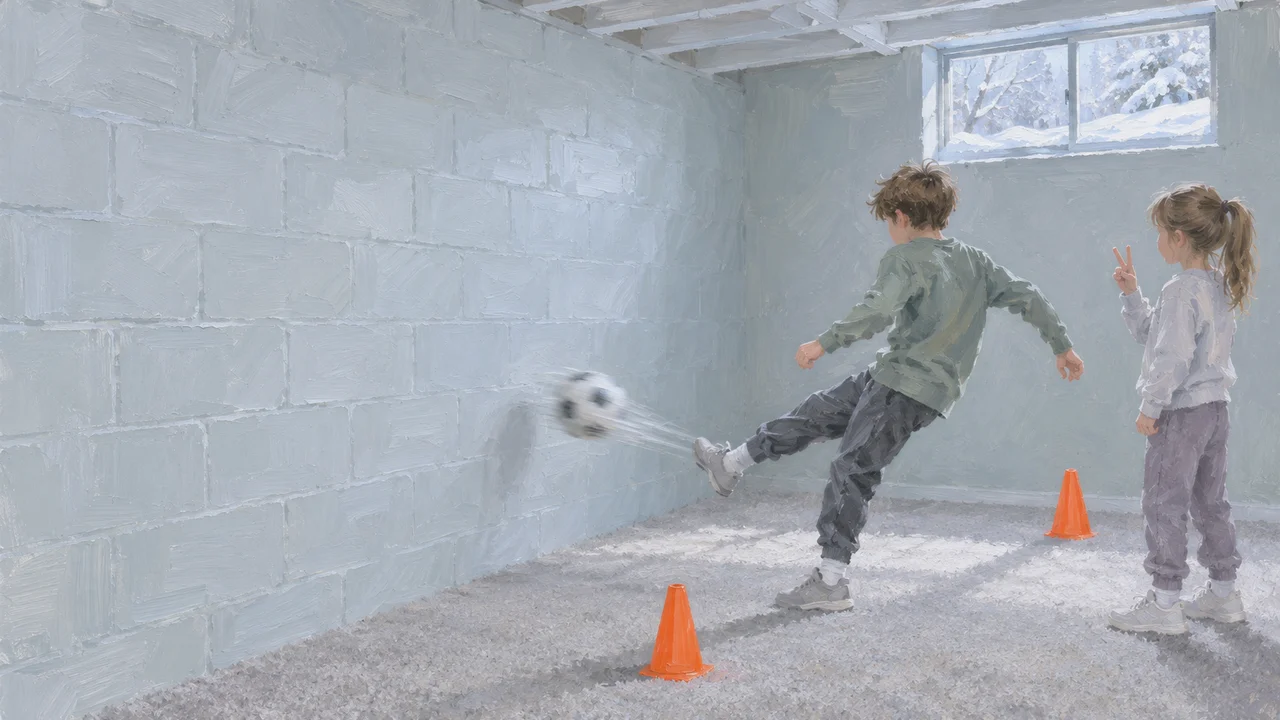
Ball mastery, written as one skill, one count, and one time limit. My off-day assignments run 15 to 30 minutes and sound like this: "50 inside-foot passes with your left against the wall in 10 minutes." A player can finish that alone with a ball and a wall, and over a break, a ball and a wall may be all a player has.
Use the same kind of assignment your players already know from off days, and send more of them. During my season, we practice three times a week and the home plan fills the other four days. Over a break, the home plan carries the whole week. My post on getting players to practice on off days covers how I write and send those assignments.
Pick skills your first practice back will need. If that practice opens with a possession game, assign passing against a wall with both feet. The two-target redirect in my post on building first touch at home works well here, because it takes two cones, or two shoes, and a flat wall.
One limit applies to all of this. My 15 to 30 minute range comes from a team of 9-to-11-year-olds, and I haven't tested it with other ages.
How many days a week should you assign over a break?
Five at most, with two days off. The American Academy of Pediatrics says kids shouldn't be required to play or train more than 5 to 6 days a week, on its HealthyChildren.org page about preventing overuse injuries in young athletes. The AAP last updated that page on January 22, 2024, and I checked it on October 22, 2026.
Then plan for misses. During the season, I plan for 75% of my players to do 75% of the work. On a five-day break week, 75% comes to about four days. If your plan needs every player on every assigned day, it has no room for a holiday trip.
You can build in rest days and keep the habit. This fall, our Hardest Worker award went to a player who logged 23 of 24 assigned days in preseason and 73 of 80 during the season. That 80-day stretch already built in five rest days, and our state championship post covers how his work fit into the rest of the season.
Do NOT double the next day's count after a miss. A player who missed a day restarts at the normal count, with no lecture.
How should the plan change from week one to week four?
Give every player the same assignments for the first two weeks, then personalize. My off-day plan uses that order. Identical assignments let the habit form before anything personalizes, and no player has to wonder whether they got the easy version.
A two-week break ends before you'd personalize anything, so every player gets the same assignments for the whole break. A longer break gives you room for each player's development plan. My players each have three items, one technical, one tactical, and one mental, and at least one item builds on a strength.
| Break length | What to assign |
|---|---|
| Two weeks | The same assignments for every player, up to five days a week, for the whole break. |
| Three to four weeks | The same assignments for two weeks, then one development-plan item per player alongside the team assignment. |
| More than a month | Time off first, then two weeks of identical assignments before the first practice back. |
What if the break lasts a month or longer?
Give some of it back to your players as time off. The same AAP page says kids should get at least 2 to 3 months off from any given sport during the year, and it says families can split that time into one-month breaks. A long gap between seasons may be the rest your players need, so ask your club how it treats the break before you fill all of it.
That puts two goals against each other, and I don't have a clean answer. You want players sharp on day one, and you want them rested. My best guess is to protect the rest first and start assignments again two weeks before the first practice back.
My own preseason is the closest thing I have to data on that ramp. In the two weeks before my season, 13 of my players used Train Daily, and on day one their touch was way ahead of the same team a year earlier. That's my observation as their coach, not a controlled test.
How do you keep players doing the work when you can't see them?
Make completion visible to the team. Over a break, you lose the practice-night check-in, so you need a record you can read from home. A team-only leaderboard and streaks show you who finished, and players see each other's results without any public exposure.
Give the team a shared target too. Set a combined count of minutes or touches for the break, so a player who isn't chasing the top of the leaderboard still has a reason to log a session. A rivalry can help as well. In late September, one of my players passed a teammate on our leaderboard and gave him a hard time about it at a Thursday practice, and the teammate passed him back that weekend. My post on competition between teammates covers when that kind of contest helps and when it hurts.
You won't see your players for weeks, so you need a record you can check from your couch. Train Daily for coaches lets you pick a drill from the video library, add a note and a reinforcement question, and send it in about two minutes a day. As of October 22, 2026, it's free for coaches and players, with no card and no trial period.
What should you tell parents before the break starts?
Send one short message with the assignment, the training days, the session length, and where to find the work. In week one of my season, my Friday message to parents ended with three sentences about what the kids could do on Sunday and where to find it. A break message can stay that short.
Name the rest days in the same message. Parents planning a trip want to know whether you expect work on the holiday itself, and when you list the rest days, you answer that before anyone asks.
Tell parents how a missed stretch works, too. If a player spends a week at a relative's house without a ball, the player picks up at the normal count after getting home. Parents who know that rule can book the trip without worrying about makeup work.
How do you keep tactical ideas from slipping over a break?
Attach a reinforcement question to the assignment. I teach in two-to-four-word cues and repeat them in the assignment, the question, and the practice session. A question can be as short as "Where does the center back stand on corner kicks?" You'll get a weekly read on what stuck from the answers.
Add a scanning layer when a sibling or cousin is around. One person holds up fingers while the player works, and the player calls out the number before the next touch. My players hear "Picture, then ball" at every practice from day one, and my post on teaching scanning covers the drill and the 3v3 format I use to test it.
In the last week of the break, put the cue your first practice will use into the question. I check retention with a specific question instead of a general one, because "what's the first thing that tells you to press?" gets an answer you can grade. My post on building a season curriculum covers how I pick the one or two ideas worth carrying across a season.
Should players do fitness work over a break?
Keep the break plan to ball mastery. My off-day plan has no sprints and no fitness work, and my players get conditioning from small-sided games. If you want a conditioning plan, talk with a certified athletic trainer, and send parents with health questions to their child's pediatrician.
What should the first practice back look like?
Run a session your players already know. Chris Ramsey has talked about players absorbing roughly 30% of a new session the first time through and 60% the second time. With a repeat, your players spend their attention on the ball instead of on new instructions, and you can watch touch without new teaching in the way.
Watch first touch in the opening game, before you teach anything. That's your first look at whether the break work happened. Then ask the cue question from the break assignments, and listen for who answers first. My post on Play-Practice-Play covers the opening game I'd use for that check.
You want a break plan you can set once and check from anywhere. With Train Daily for coaches, you can flag a day as a challenge, give bonus points for extra effort, and watch the team-only leaderboard until the first practice back.
What to do this week
- Write one break assignment with a skill, a count, and a time limit, and send the same assignments to every player for the first two weeks.
- Send parents one message with the assignment, the training days, the rest days, and where to find the work.
- Pick one way to see who finished, and plan for 75% of players doing 75% of the work.
Frequently asked questions
How long should youth soccer players train each day over a break?
My plan for ages 9 to 11 uses 15 to 30 minutes of ball mastery on each assigned day. I write each assignment with a skill, a count, and a time limit, so a player knows when the session is done. I haven't tested that range with other age groups.
How many days a week should players train during a break?
Assign five days at most and leave two days off. The American Academy of Pediatrics says kids shouldn't be required to play or train more than 5 to 6 days a week. Plan for 75% of players to do 75% of the work, which comes to about four days on a five-day week.
Should youth soccer players take a complete break from soccer?
For part of the year, yes. The AAP says kids should get at least 2 to 3 months off from any given sport each year, and families can split that into one-month breaks. For a break longer than a month, protect the rest first and start assignments two weeks before the first practice back.
How do you get players to practice over a break with no team practice?
Make completion visible, give the team a shared target, and tell parents the plan before the break starts. A team-only leaderboard and streaks let players see each other's results. Send parents a short message with the assignment, the training days, and the rest days.
Can players come back from a break better than they left?
One coach says his did. Armando Sanchez of Blair YSC reported on the Train Daily coaches page that his players returned from two weeks off with better ball skills than they had before the time off. I can't verify that report, and Train Daily is my app. On my own team, 13 players used it in the two weeks before my season, and their touch on day one was way ahead of the same team a year earlier, which is my observation and not a controlled test.