What is Scanning in Soccer, and How Can My Kid Practice it at Home?
Scanning in soccer is the habit of looking around, usually with quick head turns, to see where teammates, opponents, and open space are before the ball arrives. A player who scans already knows what the first touch is for. Your kid can practice it at home with one helper, a ball, and a few cones.
I co-founded Train Daily and coach youth soccer in Fort Wayne, IN. I didn't grow up playing high-level soccer myself, and if I could teach my players only one thing, it would be looking around before the ball arrives. They hear "Picture, then ball" at every practice from day one.
What is scanning in soccer?
Scanning is a head turn, or a few of them, that happens while the ball is still on its way to the player. The player takes a quick picture of where teammates, opponents, and open space are, then uses the first touch to act on that picture.
My cue for it is "Picture, then ball." Take the picture with your eyes first, then deal with the ball. Heads-up dribbling shows a player what's in front of them. Scanning adds the view over the shoulder and off to the side, which is the information a player needs before a pass arrives.
I tie it to what we call Phase 1, the moments when we have the ball and each player's job is to keep it and score. A player can't play forward first without already knowing what's forward, and scanning is how a player finds out. If you want to see where scanning sits next to the other skills at one age, my post on what a 9-year-old should practice at home covers it.
How often do professional players scan?
Professional players in one English Premier League study averaged 3.0 scans in the 10 seconds before they received the ball. Geir Jordet and seven co-authors tracked 27 male players at one club across 21 home matches in the 2017/18 season and published the results in Frontiers in Psychology in 2020. That works out to 0.44 scans per second. Central midfielders scanned most often, and forwards scanned least often.
The players also scanned more when their team kept the ball (0.46 scans per second) than when it lost the ball (0.37). The authors describe the link between scanning and completed passes as small but positive, and they say technical ability and pass difficulty matter more for completing a pass than scanning does. I checked the paper on November 5, 2026.
Those numbers come from adult professionals, so use them as a picture of the habit instead of a target for your kid. Scanning is a few quick glances spread across the seconds before a pass arrives.
How can I tell if my kid scans?
Spend five minutes of a game watching your kid instead of the ball. That's my advice to the parents on my team, because the habit shows up when the ball is somewhere else. Look for three things.
- Head turns while the ball is on the other side of the field, to check where teammates and defenders are.
- Small position adjustments as the play moves, such as sliding into a lane where a pass could arrive.
- A plan when the ball arrives, with a first touch that goes somewhere on purpose instead of a surprised stop.
I've asked one player's parents to watch where their son stood before he received a pass. Was he positioned somewhere useful when the ball got there? I also tell parents to watch how quickly our midfielders switch the ball from one side of the field to the other, ideally in one or two touches. A midfielder can't do that without knowing what's available before the ball arrives.
Then praise the decision, even when the pass doesn't work. A player who looked, saw an open teammate, and tried the pass made the right read. "Let's go!" from the sideline is perfect. The coaching can wait for practice.
How can my kid practice scanning at home?
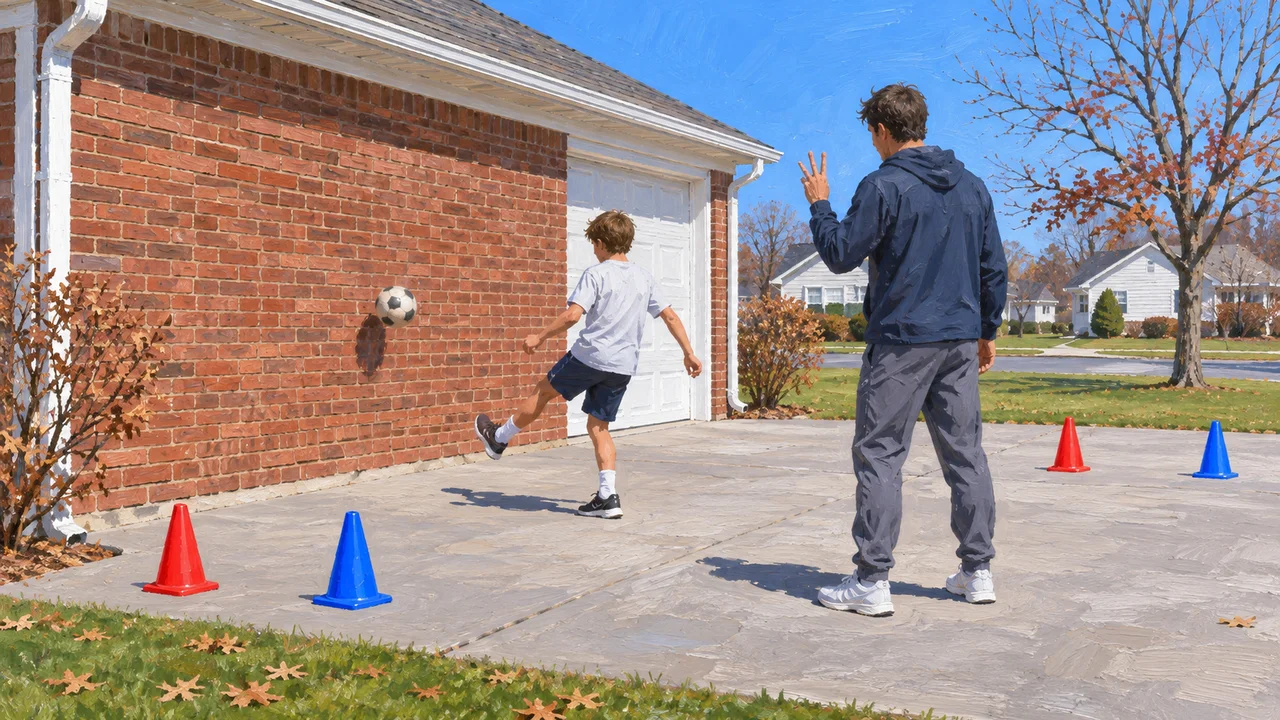
A head turn needs something to read. If nothing changes behind your kid, the look gathers no information, so each rung below gives your kid a changing picture. You are the helper. You need a ball, a wall or other rebounder, and four cones in two colors.
Rung one is the finger count. Your kid passes against the wall while you stand behind with one to five fingers up. Before the ball comes back, your kid looks over a shoulder and calls the number out loud, then takes a touch and passes again. Run it for about ten minutes. This rung takes zero soccer knowledge.
Rung one gets your kid looking before the touch. My post on building a first touch at home covers the touch itself, including a two-target redirect and how to add a scan call to it.
Rung two is the colored gates. Our team ran a version of it this summer with a server, a receiver, and a defender. The defender ran through one of two colored gates, and the gate decided which side the pressure came from. I didn't call the side out loud, so the receiver found out by looking. The receiver's job was to look before the ball arrived, take a first touch away from the pressure, and pass.
At home, you can run it with one helper. Put two gates about five yards behind your kid, one on each side, using two red cones for one gate and two blue cones for the other. Stand behind your kid between the gates. Your kid passes into the wall, and as the ball travels you walk through one gate. Before the ball returns, your kid calls the color of the gate you chose, then takes the first touch away from you and passes back to the wall.
Judge the timing. The head turn has to come before the ball arrives, and the first touch has to go somewhere useful. If your kid looks after the ball is at their feet, or takes a touch straight back toward you, the rep taught nothing, so say "again" and reset. Walk through the gate, or jog at most.
Rung three is the full version my team ran. Get a second helper, such as a sibling or a friend. One person serves from the front, and the other walks or jogs through a gate behind your kid. Your kid scans, calls the color, takes the first touch away from the defender, and passes back to the server. Rotate after three or four reps so players don't stand around. The server becomes the receiver, the receiver becomes the defender, and the defender becomes the server.
Scanning needs repeats on the days your team doesn't meet. Train Daily puts the day's reps in your kid's Today tab, with reps assigned by age and focus and a leaderboard of other players their age. Train Daily is free to use, and you don't need a card to sign up.
Is there a game version for siblings and friends?
Yes. We call ours Moving Open Cone. Each group of cones has one open spot, and a player passes the ball and immediately runs to the open cone. The spot keeps changing, so players can't decide where to go without looking around first. The first time we ran it this fall, the competition finished 22-21, and we had some of the best ball movement we'd seen all season.
At home, three players and four cones make a group. Pass to a teammate, run to the open cone, and count completed passes in two minutes. Then play again and try to beat the total.
What if I don't know soccer?
Holding up fingers and walking through a gate take no soccer knowledge, and your kid does the soccer part. I can't demonstrate a move at full speed myself, and I run these drills anyway because the helper's job is to change the picture.
After a few reps, ask your kid what the picture looked like before the ball arrived. A kid who can answer was looking.
If the whole game is new to you, you can still be useful from the sideline and the driveway. My post on helping your kid when you didn't grow up playing covers what to do at home and what to watch for during games.
What to do this week
- Watch your kid for five minutes at the next game, and write down what they do when the ball is somewhere else.
- Run rung one for ten minutes on a day without practice, and move to the gates when your kid calls the number before the ball comes back on nearly every rep.
- Praise one decision, even if the pass didn't work.
Scanning becomes a habit through small repeats, and the days between practices are where those repeats happen. If you want a daily rep handed to your kid without building the routine yourself, sign your kid up at Train Daily. If your kid resists practice, my post on getting a kid to practice without nagging suggests handing over a task with a number on it and keeping it the same for two weeks.
Frequently asked questions
Is scanning the same as keeping your head up?
Keeping your head up means looking at the field instead of the ball while dribbling. Scanning means turning your head to gather specific information, such as where a teammate is open or where a defender is closing, and it happens before the ball arrives. A player can dribble with the head up and still skip scanning.
How many times should a player scan before receiving the ball?
In one Premier League study, professional players averaged 3.0 scans in the 10 seconds before they received the ball (Jordet et al., 2020, checked November 5, 2026). That describes adult professionals, so it isn't a target for a 9-year-old. A better goal for your kid is a head turn before the ball arrives on every rep of a drill.
Can my kid practice scanning alone?
Your kid can practice the head turn alone, but a head turn needs something to read. With a wall in front and empty space behind, nothing changes, so the look gathers no information. One helper holding up fingers or walking through a gate fixes that. A sibling or a friend works as well as a parent.
What should I say when my kid doesn't look before the ball arrives?
During a drill, reset the rep and say "again." If you want a question, ask what your kid saw before the ball got there. Praise the reps where the head turn came early, and praise the decision even when the pass fails. During a game, "Let's go!" is the whole sideline script.
How long should a scanning session at home last?
Ten minutes on one rung fits a session. On days without practice, my team's plan is 15 to 30 minutes of ball mastery, and a scanning rung fits inside that block. Run the same rung for a few sessions before moving up, the same way you would build any daily practice habit.
Do forwards and defenders need to scan, or only midfielders?
The Premier League study found central midfielders scanned most often and forwards least often, but all players receive the ball and win it back. On my team, each player's job with the ball is to keep it and score, and without it to win it back, so all positions need the picture before the ball arrives.