A Two-Hour Middle School Soccer Practice Plan for School Coaches
A middle school soccer practice plan for two hours comes down to four blocks: a ball-first warm-up, a short opening game, a longer teaching block built around one theme, and a scrimmage that shows whether the teaching worked. Below is the time breakdown, plus what changes when you're the only coach on the field.
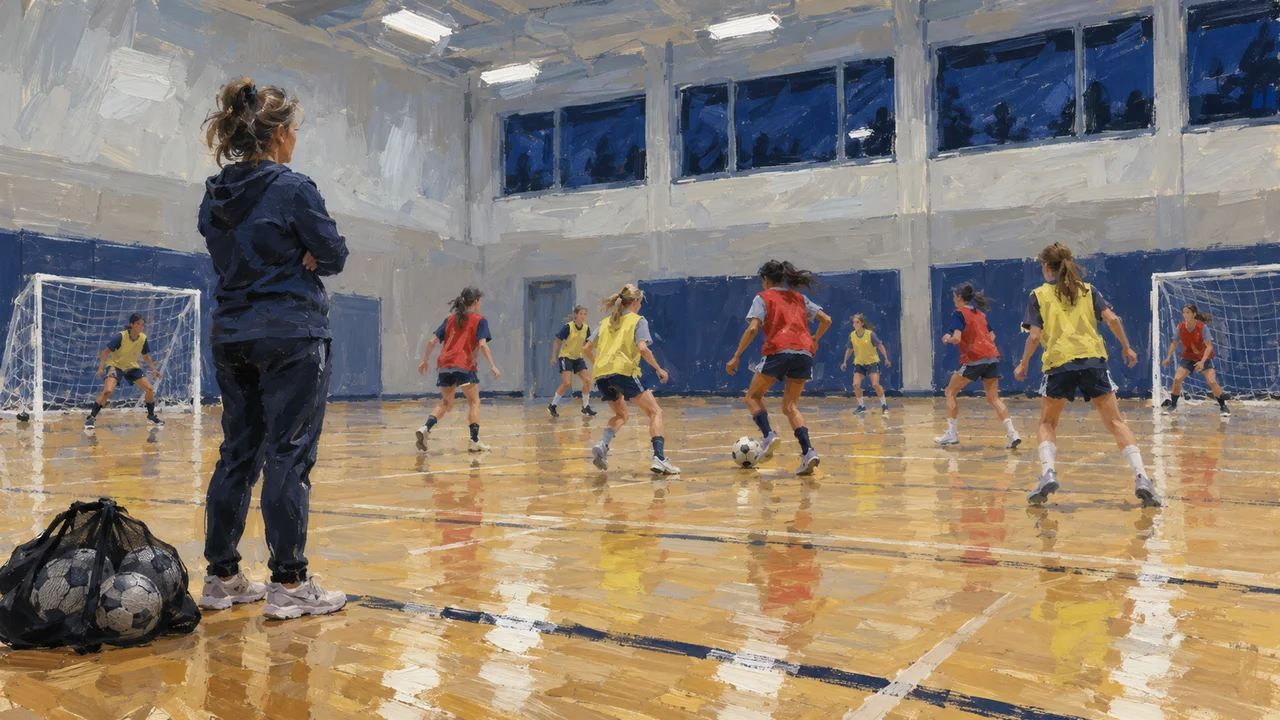
I co-founded Train Daily and coach youth soccer in Fort Wayne, IN. Middle school practice comes with a specific set of constraints a club session doesn't have. You usually get one coach, a two-hour window if you're lucky, and twenty-some players who range from players who've logged years of travel soccer to players who signed up because a friend did. A practice plan has to survive all three realities at once.
How long should a middle school soccer practice be?
Two hours works, and it's the standard window for most middle school programs that practice after school. Inside that window, the time allocation matters more than the total. I run my own two-hour sessions on a similar split, roughly 20 to 25 minutes of warm-up, a short opening scrimmage, 45 to 55 minutes of focused teaching, and a longer scrimmage to close. A two-hour practice that spends 45 minutes on warm-up and cone setups has the same clock as one that spends 20 on it. Only one of those two actually teaches something.
What should the warm-up look like in a middle school soccer practice?
Skip the lines and the static stretching. A ball-first warm-up gets a middle schooler's brain and body ready faster than a lap and a stretch circle, and it banks touches you'd otherwise lose. My own team's warm-up runs 23 to 25 minutes, almost all of it with a ball at every player's feet, and it includes 5 to 10 minutes of ball mastery folded into whatever game gets players moving.
Without an assistant running a second group, cut this down to one activity instead of three. Put every player on a ball, call out a direction or a number of touches, and let them move through the space. Add a scanning demand early, since middle schoolers can handle more of this than most coaches assume. Call out a color or hold up fingers while they're dribbling and make them yell out what they see. That trains two things in the same 20 minutes instead of one, and it's the same scanning habit I build into every practice from day one rather than saving it for a standalone drill.
How do you structure the middle of a two-hour soccer practice?
Use Play-Practice-Play. Players start in a small game, 2v2 or 3v3, while you watch and say almost nothing. That tells you what to coach for the next block. The middle block is where the day's one theme gets taught through a game-like activity with three versions, an easier one, the standard one, and a harder one, so you can move a player up or down without stopping the whole group. The closing block is a bigger scrimmage where you check whether the teaching actually showed up in play.
My post on planning a youth practice around this same shape covers the full version with multiple coaches running parallel stations. Alone, the version that survives is simpler. Pick one theme. Build one practice-phase activity around it with an easy version and a hard version. Spend the rest of your prep time deciding what you'll say in the 20 seconds after a mistake, not on drawing a fourth drill nobody gets to.
What do you do when a middle school soccer practice starts to fall apart?
Keep a shooting game or small-sided scrimmage ready to go, and don't touch it until you need it. I call this the gift in the back pocket. Energy in a middle school practice dies for reasons that have nothing to do with your plan. A long water break, a group of friends geeking out about something unrelated, a drill that's run ten minutes past its useful life. When that happens, drop the plan and go straight to the gift.
The reason this works is recency bias, not magic. Players remember a rough stretch followed by a strong finish as a good practice. They remember a strong middle followed by a rough finish as a bad one, even when the middle had the better coaching in it. I treat my own written plan as a hypothesis I'm allowed to throw out mid-session, and the gift is the one piece of that hypothesis I protect no matter what else changes.
A solo coach running a two-hour practice can't watch every rep, which is exactly why what happens on off-days matters more. Train Daily assigns short, specific ball-mastery work for the days you're not on the field, so the touches a middle schooler needs don't all have to happen inside your two hours.
How do you run a middle school practice without an assistant coach?
Build in competitive stakes instead of leaning on extra supervision. Winners stay on, losers run the next water bottle to midfield, the first group done gets to pick the next game. A locked small-sided game with something on the line holds a group's attention without you standing over it narrating. That matters more, not less, with one coach, since you can't be in two places watching two groups at once.
It also helps to keep most of practice time inside games that already contain attack, defense, and transition, rather than running isolated passing lines or shooting lines you have to supervise one player at a time. A 4v4 to small goals teaches more per minute than a cone-weave line, and it runs itself once you've explained it once. A lot of these games come straight from the exercise bank I use for my own 9v9 practices, since the formats scale down to smaller numbers without much adjustment.
What size scrimmages work best for a middle school soccer practice?
Smaller than you'd run with a club team the same age, if you're coaching alone. A 4v4 or 5v5 to small goals needs almost no supervision once it's set up, because the scoring polices the game for you. An 8v8 or 11v11 scrimmage with one coach means long stretches where most matchups go uncorrected, since you can only watch one of them at a time. Save the bigger scrimmage for the 2nd Play block at the end, when the goal is checking the theme instead of teaching it, and build the Practice phase itself out of 3v3s and 4v4s you can actually watch.
The themed teaching block works best when it isn't the first time players have seen the idea. My post on getting a roster to touch the ball between sessions covers how to assign specific, countable off-day work, so Monday's teaching point isn't brand new to half the group.
How do you handle different skill levels in the same middle school practice?
Scale the activity, not the roster. Splitting a middle school team into an A group and a B group for the whole practice usually backfires, since it tells the B group where they stand before you've taught them anything. Instead, run one activity with an easier version and a harder version, and move individual players between them based on how a rep actually goes, not on who you assumed would struggle going in.
A 3v2 that's too easy for your strongest attacker and too hard for your newest player isn't broken. It's an activity with two settings. Widen the field or add a touch limit to make it harder. Add a neutral player or shrink the field to make it easier. The group stays together, the game stays the same, and the challenge moves underneath it.
What should a middle school practice do about limited or shared field time?
Plan for the minutes you actually have, not the minutes you'd prefer. Shared fields and tight after-school windows are the normal condition for a middle school program, not the exception. If a match against a travel club later in the week is the standard you're building toward, a two-hour, full-field practice twice a week beats a 90-minute, half-field practice three times a week, since the extra 30 minutes usually goes to the themed block where the real teaching happens.
If your field time shrinks in a given week, cut from the scrimmage before you cut from the themed block. A shorter 2nd Play still checks whether the teaching landed. A missing Practice phase means there was nothing to check in the first place.
How much water break time does a two-hour middle school practice need?
Plan for more than you'd guess. A two-hour after-school practice usually follows a full school day, and a middle school group fades faster than most coaches expect, especially early in the season before conditioning catches up. I build two water stops into my own two-hour sessions beyond the one at halftime of the closing scrimmage, and I treat each stop as part of the practice rather than dead time, since it's also the moment a quick word to one or two players lands better than anything said in front of the whole group.
Sample two-hour middle school soccer practice plan
| Time | Block | What happens |
|---|---|---|
| 0:00–0:10 | Arrival | Players touch a ball the moment they're on the field instead of forming a line or a stretching circle. |
| 0:10–0:25 | Warm-up | Ball-mastery game with a scanning call layered in. |
| 0:25–0:35 | 1st Play | Small, low-stakes game, 2v2 or 3v3. Coach watches and says little. |
| 0:35–1:20 | Practice phase | One themed activity, run in an easier and a harder version, scaled to whoever's in each group. |
| 1:20–1:50 | 2nd Play | Bigger scrimmage. Check whether the day's theme shows up without a prompt. |
| 1:50–2:00 | Gift / wrap-up | If the group needs it, swap in the shooting game or scrimmage held in reserve. Close with a quick word. |
Keep the themed block, 0:35 to 1:20, built around one idea. A middle school group that gets three new concepts in one practice retains none of them well. A group that gets one, repeated with an easy and a hard version, actually walks away able to do it.
Where to start with your next middle school soccer practice
Pick one theme for the week before you touch a single cone. Build the warm-up around the ball, not a lap. Keep a gift in your back pocket and use it the moment the group's energy turns, not after you've already lost them. Those three habits do more for a two-hour practice than any new drill will.
If your program runs into the high school level, the same off-day thinking carries over. My post on training at home when team sessions are limited covers how that structure shifts as players get older and schedules get tighter.
If you're looking for a way to keep that teaching point alive between practices without adding to your own week, that's what we built Train Daily to do. Coaches assign a short piece of off-day work in about two minutes, and players check it off on their own. You can see how it works on the coaches page.